Call Center Tips


Call Center

From both my professional and personal experience with Call Centers, I have developed some strong opinions about how they should be run. I worked as a call center agent in various jobs and have also managed three Call Centers at three different companies. It is a tough business since companies don’t like to invest in them.  Working in them can feel like being in the front line of a battlefield.  My professional experience forged an acute awareness of the failings of Call Centers, especially those that I’ve needed to contact as a consumer.  Consequently, I will share with you eight tips all Call Centers should embrace in order to maximize their success.  Please note that this is not intended to be an exhaustive list. Continue reading

Customer Service: An Alternative

2016_frontier-header-redIntroduction

Recently, I signed up for Frontier Communications’ cable and internet service and experienced customer service failures at every step along the way.  In this post, I’ll describe those failures and give recommendations on how Frontier can improve.  Despite my advice, however, these multiple failures caused me to cancel the service one week after it was installed.  I was greatly disappointed, as I’ve yearned to get rid of Comcast for a long time.  You will see that the problems have very simple solutions, yet very large companies still stumble over them time and time again.  As the title of this post suggests, this is NOT how service should be delivered.

To give you background, I received a flyer in the mail from Frontier asking me to sign up for a more customizable internet and cable TV package that could save me money. My biggest goal was to find a cheaper alternative to Comcast.  Since I need two international channels, Comcast requires that I purchase a high-end cable package beyond what I need in order to get those channels.  I wanted to get out of this clever pricing trap and decided to give Frontier a try.  I checked the link in the flyer and found that both of these channels were available in the package that fit me best.  I called the order line and purchased a package that gave me every channel I ever needed, plus the two international channels; all at a much cheaper price.  I was very hopeful.


The Details

The installation became the trigger for all the problems to occur. The installation was scheduled on a Saturday; a great convenience. The job involved drilling holes through the house and setting up all the relevant equipment in the garage.  This took about 90 minutes.  Once the tech left, the problems started to mount.  In summary, they are:

  1. The tech left without providing me any account or channel information.
  2. I could not find one of the international channels I ordered. (GMA Pinoy TV from the Philippines)
  3. While trying to solve the problem, Frontier’s service process failed at every point along the way.

For the remainder of the post, I will describe several experiences that fall under the three primary areas of failure listed above.


Difficult to Find the Right Contact Number

I found it to be difficult to find the right phone number to contact customer service. It is not clear which moniker the company prefers; is it Frontier? FIOS? Verizon?  I searched on “Frontier FIOS” and got connected to Verizon Wireless for some reason.  The agent told me that I need to contact Verizon Landline for my problem.  Verizon Landline?  How could that be?  He then transferred me to the “correct number”.  This number only led me to a recording that saying that it was no longer in service and to dial another one.  I didn’t write it down in time and the call hung up abruptly.  Three things:  1) Why would an agent send me to a bad number?  I suppose it would be too much to ask for a warm handoff, too.  2) Why couldn’t the bad number simply be rerouted to a functional number?  This is Verizon.  Don’t they do phones?  3) What should I be searching on to find the company?  It seems that Frontier has a branding problem.  It is not clear who they are or where callers should go.

Recommendations:

    1. Agents should maximize the situations where they perform a warm handoff. I know it consumes a resource, but the customer satisfaction and reputation gained always make a huge difference. This is a Call Center 101 practice that still shocks me when not utilized.
    2. It may be difficult, but scrub the internet of the company references that don’t match your brand choice. At the very least, do website redirects or put an easy-to-use web page at the top of the search results that summarizes which number provides which service.
    3. Never send a customer to a bad number that hangs up on you. I hope this is self-evident.
    4. Train agents to handle misrouted calls more effectively. In several cases during this experience, agents had little understanding of what the other functions of the overall company do.

(Update:  I’ve since noticed that FIOS straddles both Verizon and Frontier in different ways.  Since I didn’t know this at the time, that is how I wound up at Verizon.  It may be too much to expect a Verizon agent to do a warm handoff to Frontier, but since there must be many people getting to the wrong place because of the FIOS confusion, agents should be prepared for this.)


Installation Problems

I was not given a channel guide or any account or customer service information when the installation occurred. The installation took over an hour and the man was polite, but he left abruptly without leaving any documentation behind. With Comcast, I was given several pieces of information that helped me move forward with my service (even more than I needed)

Recommendations:

  1. At the very least, hand the customer a simple brochure or flyer with basic information such as the service number and the channel guide.
  2. Many companies leave you with some sort of receipt that summarizes the service rendered. Frequently, that includes the account number on it. I usually throw these away or stuff them out of sight somewhere, but it at least gives the customer an opportunity to dig for information when in a pinch.

Poor Experiences with Service Personnel

I called the Service number once I found one (don’t remember how). The man spent a great deal of time with me, did a lot of searching around to understand why the channel I wanted didn’t appear.  He expressed good empathy, patience, and willingness to help. But..!  Once he ran out of ideas on how to address the issue, he suggested I go to technical support because they may be able to find a technical glitch that is preventing my channel from appearing.  I didn’t know how that could be, but I went along with it simply to get another pair of eyes on the issue.  He transferred me to an actual person, which was positive.  However, he did not brief the agent on the situation nor give her my account information.  I already began to boil, but when the agent told me that she had no ability to look my account number up, I wailed in despair.  The agent felt horrible, as would be a normal reaction in this circumstance.  It was clear that she could not help at all, so I hung up and started over.

I made another call to a local Frontier sales office. At the time I was still flailing, trying to find someone who could help, so I called a local Beaverton sales office.  The woman who answered tried to help but couldn’t, so she told me she would research my situation and call me back.  She never called.  I am a trustworthy person, so I didn’t ask for a name.  Both experiences mentioned in this section made it clear that Frontier was no longer for me.

Recommendations:

    1. Always, always do a warm handoff. As stated before, this should be considered a Help Desk 101 procedure.
    2. Enable all agents, anywhere, to be able to look up customer information. I’m still confounded by the technical support agent’s inability to look me up. Even if her particular system couldn’t do it, it would seem useful that a supervisor or some escalation procedure could handle that quickly. This was clearly an administrative issue and not a technical one.
    3. The technical agent seemed to have become frozen and embarrassed. She validated that I had been handled incorrectly, but couldn’t offer any useable alternative. There should always be a refuge for an agent to go to when they are stuck. Management needs to provide help for the exceptions.

Signed me up for a service they didn’t have

While on the phone with the first service agent in #3, I began looking harder for an answer on the web. I eventually found a website which showed that my desired channel was available in California but not in Oregon.  That seemed to be the ultimate answer.  The agent wasn’t able to confirm this, so it was up to me to decide for myself.  I decided that it was true and that it was time to cancel my service.

The root cause of my problem was that the original salesperson sold me a service that they could not deliver. As she was very kind and did a good job taking the order, she simply did not check nor know to check whether my channel was available in my state.  This would seem to be a very standard step to take since it is generally well known that cable companies are subdivided by state due to regulatory constraints.  So too, it is inevitable that each state has different demographics and tastes, so channel lineups wind up being different.  Unfortunately, the advertising flyer led me to a web page that listed the channel I wanted as available.  It’s the reason why I pursued the service in the first place.

Recommendations:

    1. Frontier must commit itself to accuracy on their websites. For companies, like this, it is a stretch to expect it as they seem to operate unethically in many cases.
    2. Train the sales staff or put a check in the system that ensures that orders are accurate.
    3. Train the service and technical staff that different states offer different services or create a check in the system so that it is a standard process to verify the order’s accuracy
    4. Require the home installer to walk you through the service and validate that everything works properly

Closing the account was needlessly time consuming

I called to close my account and waited on hold for 50 minutes. This was on a Saturday afternoon. I was quite committed to doing this, so my indignation at the long wait was reasonably restrained.  The agent was professional and made the official diagnosis that the salesperson did not verify that my channel was unavailable in Oregon.  This was a frustrating conclusion, but it was at least finally acknowledged by Frontier.  I was particularly averse to paying my bill.  The agent could look up my balance but could not do anything about it.  She told me that I needed to call the billing department for that.  I complained that I didn’t want to wait on hold for another 50 minutes.  With a mild retort, she exclaimed that three call centers had been wiped out by hurricanes and that was why the waiting times were so long. This was meant to make me feel guilty, which worked, but there were probably better ways to handle this that I’ll discuss below.

Lastly, closing the account really means that it continues working until the end of the month so that you have to pay for the full billing cycle. This is not unusual, but I consider it yet another sneaky method used by many companies to squeeze out more money.  I gave up on calling the billing department.  It was enough for one day.

Recommendations:

    1. I hope a 50 minute wait was an aberration. Regardless, many call centers use a system that can tell the caller their wait time. This should be a standard feature for all call centers.
    2. If the wait time is extremely long due to hurricanes wiping out a company’s call centers, that company should record a message telling the caller about it. Setting expectations is one of the most important customer service techniques that can be used. Spending the time to record a message saying, “We’re sorry that hold times are especially long today. The recent hurricanes have damaged some of our call centers, so our capacity has been reduced significantly. We ask for your patience during this difficult time while those impacted by the disaster make a recovery.” Instantly, you have set expectations, provided an empathetic explanation, and diffused customer frustration.

The pricing is deceitful

I’ll sound like a whiny crank, but Frontier told me it would cost $86 a month, yet it turned out to be close to $125. I know some or all of it are taxes, etc., but surely almost $40 more per month should merit a mention.  This is deceitful, just like the airline and hotel industries.  You have to play a game to try to understand the real price.  As customers, we are tired of being jerked around on real numbers.  In this case, it Frontier had told me up front that it was $125, I still would have done it since it was still cheaper than Comcast.  What are they afraid of?

Recommendations:

  1. Honesty is the best policy.
  2. Give the full breakdown of the costs so that people can make a decision.
  3. Treat us with respect.

Summary:

My experience with Frontier was horrible on all counts. It appears that the company consists of multiple, disparate parts that don’t communicate well with each other. It is also evident that those responsible for the customer experience do not practice tried and true service techniques.  Lastly, my experience upheld the preconceived notion that cable and internet service companies are incompetent, corrupt, or both.  I think the billing department even intends to charge me over $100.  That would be the coup de grâce for this entire exercise.

I hope Frontier can consider this a learning experience. Things might look good from the top, but there’s a mess down below.  People want to get rid of Comcast. Frontier could be a great alternative if they can create a positive differentiation.  To Frontier, seize the day and delight the customer!


A3 Examples

Personal Effectiveness_Jul16

Uploaded below are a gradually growing archive of A3 templates I have filled out for various problem-solving efforts.  I have cleansed them of any confidential information or references to the company involved.

In some cases, I have gone back to older projects and created an A3 retroactively.

Lastly, I am not always successful fitting the contents onto one page. This is always a struggle for me.


Server Access

This A3 was a stopgap to fix an irritating problem where roles and responsibilities were unclear.  This got us by for the short-term and has since been replaced by an automated code deployment tool called Repliweb.  All users must use this service which implies that the environment is fully built and ready for developers to use as they wish.


Information Security Measures

There were many root causes to this problem, but all were addressed quite well and the improvement effort became a huge success.  It created a useful model for future efforts.


Web Security Task Force

This was a difficult, stressful, and very political battle to fix.  It represents a situation that makes me doubt that it is always a process problem.  Sometimes, it just seems like a people problem.  In this case, part of the process we created involved removing a person from participating.  Once this occurred, the whole team soared and solved the problems with ease and enthusiasm.  Interpret that how you wish!

Regardless, conquering this millstone was a huge victory for the organization.  What took weeks or months now takes one or two days.  Currently, we are writing code to automate the configuration so that it can be completed in minutes.  Looking back at this experience, it was one of our proudest achievements.


Book Review: Workplace Management

Workplace ManagementWorkplace Management

By Taiichi Ohno

Amazon Summary

This unique volume delivers a clear, concise overview of the Toyota Production System and kaizen in the very words of the architect of both of these movements, Taiichi Ohno.  Filled with insightful new commentary from global quality visionaries, Taiichi Ohno’s Workplace Management is a classic that shows how Toyota managers were taught to think.


Reader Summary

The superior person knows how to adapt.  The superior man does not fear change.

– Confucius

Taiichi Ohno offers distinct and elegant advice on a number of questions and topics concerned with the Toyota Production System.  Ohno reflects on thirty-six topics that explain how best to manage a workplace.  I will pluck out my favorite concepts and discuss their merits here.  This is not a comprehensive book review, but only a summary of my takeaways from the book.

The three areas I chose to address are:

  • To get to the Lean we know today, it was necessary to look at the problem of work in a contrary way from the prevailing wisdom.  Ohno calls it “postconventional wisdom”.
  • Words have meaning. People use terms and concepts incorrectly, which cause waste and inefficiency in the workplace.
  • Kaizen, costs, and standards.  I summarize Ohno’s main points on these topics.

On the Contrary

Taiichi Ohno makes it clear in the Preface that the Toyota Production System can be summed up in a single phrase:

Make only what you need, in the quantities you need, when you need it.1

In this quote, Taiichi Ohno refers to the most basic tenet that turned traditional production processes on its head.  The typical way of doing things called for parts to be transported to later processes as soon as they were made.  This process caused a disconnect with customer demand.  Ohno observed how easy it was for departments to feel good about the multitude of parts they could produce in a month.  However, only Ohno seemed to notice that no cars were completed in that time period.  Why?  Mass production always rewarded those who produced the most.  There was no sense that each department’s output must form an integrated set that is consumed by the customer.  To correct this, each department must operate in unison with the set.  Atypically, some departments must become idle if their contribution to the set is not needed at the moment.  This became the crux of the post-conventional wisdom that Ohno required to change the system.  He even makes a comment about himself to explain why he was able to create this type of thinking:

Nevertheless, I insisted on talking about “postconventional wisom,” perhaps because I have a contrary streak in me and tend to look at things backwards.2

Looking at things backwards creates a historical moment.  Taiichi Ohno created just-in-time production by reversing the system from push to pull.

A process that needs a part goes to an earlier process to get it.  It’s that easy.  No trouble at all.3

My Own Experience

I see this example in the IT industry all the time.  The server department pats themselves on the back for creating X servers per month.  The web services department glows when they set up Y number of web environments.  However, when the customer receives their environment, they can’t log into it because nobody thought about giving them access.  There is a very large piece missing in both examples.  Nobody (or somebody) is not noticing the true goal of the production process, to hand the keys to someone so that they can consume their product.


Words Have Meaning

Ohno likes to point out the importance of correct terminology.  Through his experience, he has seen other organizations look at work the wrong way out of habit.  The corrections he makes are central to the Lean mentality, yet hamper organizations everywhere.


Motion vs. Work

Ohno makes several points that begin to explain the concept of value vs. waste.  He picks apart typical ways of referring to activities in the workplace.  Two quotes illustrate his point.  They are:

  • Don’t manage speed or motion, manage work.4
  • If people are sweeping while waiting for parts, that’s not working.  Everyone confuses motion with work.5

Ohno accuses the traditional manufacturing industry of looking at work the wrong way.  He insists that you must look one level deeper at work activities because only some of the time spent making a product is actually… making the product.  Just because people are moving all the time, racing to and fro, cleaning, sweeping, monitoring, attending meetings, or handing off work to the next step, it doesn’t mean that they must surrender to this fate.  These “extras” are not work.  If it isn’t work, then it is taking too long or costing too much to produce the output.  I’m not a historian of Lean, but since this book was written in 1982, this could easily be a precursor to the Lean concepts of value stream and the two types of muda:

  1. Type I – non-value added activity, necessary for end customer.
  2. Type II : non-value added activity, unnecessary for end customer. The aim is to eliminate this type of wastage.

As a result, Ohno illustrates that the only activity that matters is the value-added activity that creates the product.  That’s the real work.

Organization and Orderliness6

Ohno goes down to the basic structure of the Japanese language to define words in the right way.  He defines organization as anything that “involves disposing of things you don’t need.”  Orderliness means “always having access to things you need.”  Using these two words together create an optimized working environment.  Strip away the bad and keep only the good.  If you must move everything out of the way to get what you need, then you have neither organization or orderliness. That is why keeping a clean shop floor has been such an important principle for Lean.

Processing Time and Processing Worker Hours7

Here, Ohno wants to parse the total time it takes to create a part.  In his example, a part may take five minutes to complete.  However, only one minute of the effort requires a person to mount a part on a machine and remove the part when it is finished.  The remaining four minutes is watching the machine process the part.  Since this four minutes is waste, then the remedy is to assign the person to more than one machine.  This sounds simple, but processes and production efforts across the world still calculate their time and labor estimates on the full five minutes.  Likewise, specialists still cling to their “one machine” mindset and make it difficult to contribute more cross-functionally. Once again, Ohno tells us to look deeper.

If you take this example and bring it to my own work world, I have seen, time and time again, situations where something takes 5 days to deliver but requires only 20 minutes of actual work.  It is extremely important to make people aware of this.  Even when you do that, it still may fall on deaf ears.  In these situations, you need to push for a single-piece flow experiment.  Pick the items you want to produce in one day and align your resources so that every single step occurs in one day instead of being handed off to a queue where it may not be picked up for two days.  Processing time should never be held hostage to processing worker hours.


Rate of Operability vs. Rate of Operation8

Ohno indicates how many get the two terms above backwards.  Rate of operability is defined as how much a machine is able to do work.  Related, but not the same, is the rate of operation, which varies with the demand of work.  Ohno insists that the former must be maximized but the latter should not.  Oftentimes, production facilities do the opposite.  They will let a machine die or neglect maintenance so that it functions below par, yet push active machines to produce full time without regard to customer demand. Ohno prefers that you maximize the usability of whatever machines you have.  Make them ready at all times so that they are ready for a spike in demand.  Otherwise, leave them offline but fully maintained.  If there is no demand, then the machines should not operate.  He also warns against thinking that productivity increases the more a machine produces.  Overproduction, in Ohno’s mind, is one of the worst enemies of productivity. It is always best to keep machines ready to produce only the amount needed and no more.


Kaizen

Ohno explains the importance of improvement that makes the most of what you already have.  Specifically, he states that kaizen is an operational improvement that comes up with better methods of using existing equipment.  It is most important to think of new work methods before making new tools or buying equipment.  In fact, there is no point in buying new equipment if a team doesn’t know how to do general improvements first.

Ohno elaborates further by establishing an order to pursue improvement. First, you must improve your operations.  Again, make the current operation more productive and make sure that there is an improvement in quality. Do not bring in new machines yet. If you do, people become slaves to the machines.  People with no capacity for improving operations are a problem because they like to buy new machines all the time.9

Second, you must improve your equipment.  This is a close relative of the first step, operations. What Ohno clarifies here is that the people on the shop floor must possess the skills to tinker and improve the machines. If they only solve their problems by buying new machines and using them per vendor specification, they will never squeeze out the local and custom level of capability and creativity that enhances productivity.10

Third, and last, as emphasized by Ohno is process improvement. This effort creates the flow for how machines are used and how quality is produced.  Ohno reinforces his point that no improvement is worthwhile unless the people using the process understand it and can alter it based on their knowledge on the ground. People on the front lines own the process.  They cannot work in a daze because management, technicians, or “experts” decided on the procedures.  There also cannot be reliance upon one big change to fix all ills.  Ohno makes it clear that kaizen is an ongoing activity made up of many small improvements diagnosed and implemented by the people doing the process.  Having a culture where the front line people do this every day is the optimal method for increasing productivity and quality.11


Only the Workplace Can Cut Costs

As an extension of the ongoing kaizen, companies must embed cost reduction into all their activities.  The ultimate measure of success for a manager is to do the same work with fewer people than before.  That is one reason why Ohno holds so tightly to the principle of multi-machine supervision.  So too, costs will also come down to the extent that defects are reduced.12

Cost reduction must happen all the time.  You cannot wait until times get bad to start your cost reduction efforts. It takes a long time to get results, so you must remain vigilant even when it seems easy to coast.  To have this kind of discipline, a company needs people to nag13 in order to stay committed to reducing cost.14

Lastly, Ohno makes a special note that only the workplace can cut costs.  Accounting cannot.15 No matter what quota or targets are set by Accounting, the workplace must be willing to do the work.  The workplace therefore has an obligation to take ownership of that responsibility.  They must be fanatics about cost reduction as though cost-cutting were impossible outside the workplace. So much so, that tenacity becomes the differentiating factor for how successful cost reduction becomes.  This cannot be executed by Accounting; only the shop floor can achieve it.16


Standards

Creating success from Ohno’s advice is a constant balancing act, especially when it comes to standards.  Standards must always exist, but they always must change. In order to improve, you must be able to improve from the existing standard. As Ohno states, “Standards are a kind of baseline for improvement” because standards can never be perfect.<sup17<  This can be unsettling to some who want more certainty and consistency.  However, Ohno warns that, “trying to get the perfect method from the first will quash the desire to improve.”  Consequently, people in the workplace need to accept both standards and change as two sides of the same coin.  You can’t have one without the other.

Second, Ohno spends some time discussing “chosen procedures”.  There is a good side and a bad side to this term.  The bad side says that chosen procedures are chosen by management or outside the immediate workplace.  People can hold themselves hostage to the idea that they can’t change or improve the system.  This makes it look like coercion is involved to make workers follow procedures. (maybe it’s true!)  Ohno prefers the good side, which says the frontline works choose the procedures.  The worker himself has the authority to choose.  There is no question of anything like correction when an individual adheres to procedures chosen by him or herself.18

Lastly, Ohno tells us how to choose the right standard.  In his experience, most test a process multiple times and take the average duration as the standard. Ohno disagrees and says that you should adopt the shortest time.  Why?  Because the shortest time shows how everything went right.  It has the least amount of waste.  This should be emulated, not averaged away as a statistical outlier.  Once you choose the shortest standard, then you can focus on eliminating the waste that infected all the others in the sample.


Epilogue

This is the second book I’ve ready by Taiichi Ohno.  (See my review of The Toyota Production System here)  I love Ohno’s style.  He makes everything sound so simple and clear.  You get a sense, quickly, that he is an authority on the topics he discusses.  Ohno can write about a concept in a very short amount of words, yet they explain everything.  His writing style is as efficient as his improvement systems.

I chose to read Ohno’s books to ground myself in the origins of Lean.  I’m glad I did it since it gives me perspective on how the current processes formed.  It gives me the original “5 Whys” perhaps.  Since he is the standard, I can use it as a baseline for everything else.

I recommend Workplace Management highly.  It is a short read packed with a lot of great stuff.  If I had to choose, I suppose I think that The Toyota Production System was better.  However, I feel like I get a more comprehensive understanding of the man who did so much to shape the future of manufacturing and improvement.


1  Taiichi Ohno, Workplace Management, (Cambridge, MA.:  Productivity Press, 1988), p. ix.
2  Ibid., p. 78
3 Ibid., p. 78
4  Ibid., p. 107
5  Ibid., can’t find page
6  Ibid., p. 117
7 Ibid., p. 126
8 Ibid., p. 128
9 Ibid., p. 123
10  Ibid., p. 124
11  Ibid., p. 125
12 Ibid., p. 92
13 Ibid., p. 120
14 Ibid., p. 143
15 Ibid., p. 145
16 Ibid., p. 147
17 Ibid., p. 148
18 Ibid., p. 148
sup>

12 Principles of Servant Leadership

The following 12 characteristics of Servant-Leadership have been identified by Larry Spears, CEO of the Greenleaf Center for Servant Leadership. He views them as being critical to the development of servant-leaders. These are by no means exhaustive. However, they serve to communicate the power and promise this concept offers.

There are a million of these types of lists on the web and many have merit.  I chose this one due to its emphasis on serving others.  John Maxwell refers to this concept many times when it comes to leadership.  Leaders need to sacrifice themselves for the good of others.  For now, I’ve only placed this content on my blog to put it somewhere.  I will come back in the future to write my own comments below each item.

1. Listening

Traditionally, leaders have been valued for their communication and decision making skills. Servant-leaders must reinforce these important skills by making a deep commitment to listening intently to others. Servant-leaders seek to identify and clarify the will of a group. They seek to listen receptively to what is being done and said (not just said). Listening also encompasses getting in touch with one’s inner voice, and seeking to understand what is being communicated.

2. Empathy

Servant-leaders strive to understand and empathize with others. People need to be accepted and recognized for their special and unique spirit. One must assume the good intentions of employees/partners and not reject them as people, even when forced to reject or call into question their behavior or performance.

3. Healing

Learning to heal is a powerful force for transformation and integration. One of the great strengths of servant-leadership is the potential for healing one’s self and others. In The Servant as Leader, Greenleaf writes, ―There is something subtle communicated to those being served and led if, implicit in the compact between the servant-leader and led is the understanding that the search for wholeness is something that they have.”

4. Awareness

General awareness, and especially self-awareness, strengthens the servant-leader. Making a commitment to foster awareness can be scary—one never knows what one may discover. Greenleaf observed, ―Awareness is not a giver of solace – it’s just the opposite.” Do others believe you have a strong awareness for what is going on? Servant leaders have a strong sense of what is going on around them. They are always looking for cues from their opinions and decisions. They know what’s going on and will rarely be fooled.

5. Persuasion

Servant-leaders rely on persuasion, rather than positional authority in making decisions. Servant-leaders seek to convince others, rather than coerce compliance. This particular element offers one of the clearest distinctions between the traditional authoritarian model and that of servant-leadership. The servant-leader is effective at building consensus within groups.

6. Conceptualization

Servant-leaders seek to nurture their abilities to “dream great dreams.” They have the ability to look at the organization, and any issues within the organization, from a conceptualizing perspective. This means the leader must think beyond day-to-day realities. Servant-leaders must seek a delicate balance between conceptualization and day-to-day focus.

7. Foresight

Foresight is a characteristic that enables servant-leaders to understand lessons from the past, the realities of the present, and the likely consequence of a decision in the future. It is deeply rooted in the intuitive mind.

8. Stewardship

Servant leaders are often characterized by a strong sense of stewardship. Stewardship stems from medieval times when a steward would be assigned to hone the skills and development of the young prince to prepare him for his reign. A steward in an organization is responsible for preparing it for its destiny, usually for the betterment of society. When we describe a leader as having a strong sense of stewardship, we refer to a desire to prepare the organization to contribute to the greater good of society—not unlike preparing the prince to serve the greater good of the kingdom.

9. Growth

Do employees believe that you are committed to helping them develop and grow? Servant leaders have a strong commitment to the growth of people. They believe that all employees have something to offer beyond their tangible contributions. Servant leaders work hard to help employees develop in a number of ways. Servant-leaders need to connect to others’ developmental needs and actively find ways to help them reach their true potential as employees.

10. Building Community

Do employees feel a strong sense of community? Servant leaders have a strong sense of community spirit and work hard to foster it in an organization. They believe the organization needs to function as a community and work hard to build community within. Servant-leaders are aware that the shift from local communities to large institutions as the primary shaper of humanity has changed our perceptions and caused a sense of loss. Servant-leaders seek to identify a means for building community among those who are part of the organization.

11. Calling

Do employees believe that you are willing to sacrifice self-interest for the good of the organization? Servant leaders have a natural desire to serve others. This notion of having a calling to serve is deeply rooted and values-based. The servant leaders desire to make a difference for others within the organization and will pursue opportunities to make a difference and to impact the lives of employees, the organization and the community—never for their own gain.

12. Nurturing the Spirit – JOY!!

The servant leader is someone who understands the deep human need to contribute to personally meaningful enterprises. The servant-leader nurtures the individual’s spirit through honest praise and supportive recognition. Criticisms and suggestions are not personal or harsh. The joy of the work is celebrated through means that acknowledge the value of employees’ commitment to worthwhile activities. The servant leader reminds employees to reflect on the importance of both the struggles and successes in the organization and learn from both.

Book Review – Change the Culture, Change the Game

ChangeTheCultureChange the Culture, Change the Game

By Roger Connors and Tom Smith

Executive Book Summary at www.summary.com

In Change the Culture, Change the Game, Roger Connors and Tom Smith, the recognized experts on creating a culture of enterprise-wide accountability, apply their practical and powerful strategy to helping leaders accelerate culture change, energize their organizations and create greater accountability for results.

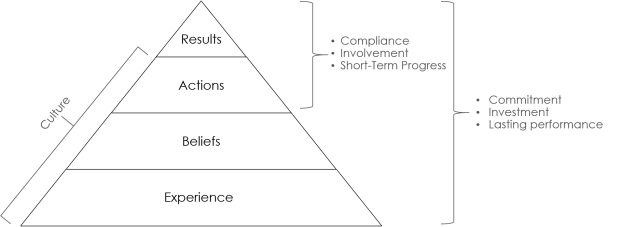
In this landmark guide to organizational culture change, the authors introduce the Results Pyramid model, a simple and memorable methodology for efficiently and effectively changing the way people think and act throughout an organization to ensure that they achieve their desired results.


Introduction

In this review, I intend to summarize and explain the method of culture change recommended by Tom Smith and Roger Connors, authors of Change the Culture, Change the Game.  I support its thesis strongly and have composed a rather lengthy analysis of the book’s messages.  I apply my own experiences throughout in order to supplement the argument.  Beware but enjoy.

Lastly, I am a novice when it comes to citing from books.  As of this writing, I don’t have citations, but do intend to do that.  There is a heavy mix of direct quotes from the book and my own language.  I will be working gradually to sorting that out.

Reader Summary

A company must manage their culture or the culture will manage them.  That firm statement serves as the core message of this book.  It is culture that creates results.  Everything else is a product of that culture.  Culture changes the way people think which changes the way they act.  To help support this precept, there are four premises that build the case for the importance of corporate culture.  They are:

  1. Beliefs create Actions.
  2. Actions do not create Beliefs.
  3. Experience creates Beliefs.
  4. Culture produces Results.

The authors use a helpful formula to illustrate the before and after of a company’s change effort.  In its simplest form, it looks like this:

Before:

A1 + B1 + C1 = R1

After:

A2 + B2 + C2 = R2

| A = Actions | B = Beliefs | C = Culture | R = Results |

These (non-mathematical) formulas tell us that a group’s actions, beliefs, and culture create the results they get.  In the first formula, whether good or bad, this is how the organization has been performing up to the time of assessment.  It could have been very good performance or completely poor performance.  It doesn’t matter.  That particular set of characteristics achieved those particular results.

The second formula tells us that in order to achieve new and improved results, R2, new and different actions, beliefs, and culture need to be created in order to make it happen. You cannot do “more of the same”.  You will only achieve R1 again, maybe R1.5, but never R2.  In other words, the results you want determine the kind of culture you need.  The culture creates results.

The book provides some other helpful premises to define how these forces work.  For lack of a better way to do it, I will list a few more of these premises:

  • Culture consists of both what people think and what they do.
  • Change the way people think, you will change the way they act.
  • Don’t create a culture of activity.  Changing the way people think is the fastest way to changing the way people act.
  • Too often, leaders attempt to change the way people act without changing the way they think, i.e., their beliefs.  As a result, they get compliance, but not commitment; involvement, but not investment; progress, but not lasting performance.

The last bullet above is a very important point.  Too often, companies create policies and procedures and enforce them to get results.   While they may operate with discipline and efficiency, they will expend too many resources on forcing compliance and creating a punitive environment.  Equally, it may even be the case that formal enforcement does not occur.  In this vacuum, customers or key stakeholders need to escalate issues in order to get action.  From both the book and my own experience, these approaches are tragically insufficient.


The Chicken or the Egg

I experience a debate frequently that asks the question:  “Which is better, create the culture first, and the culture will drive your results; or, build effective policies and procedures first and a good culture will emerge from following good habits?”  This debate rages in the same way in the psychotherapy community between cognitive therapy and behavioral therapy.  I prefer building the culture first, as it is more proactive and purposeful.

Change the Culture, Change the Game answers the question in its title.  Changing the culture is essential to driving better results.  In psychological terms, it is best to know who you are and how you achieve meaning in life in order to live a full life.  In the same way, a company needs to know what beliefs, vision, and mission it has in order to deliver the right results.

The book uses a model to explain the difference between the two competing methods.  They identify the culture’s state of accountability in two different ways; Above the Line, and Below the Line.

Below the line, people behave in unconstructive ways because they have no direction, see no reward for proactive measures, or even know how to behave at all.  This environment frustrates inspiration and action.  As examples, these behaviors inevitably emerge:

  • Cover your tail (CYA)
  • Wait and see
  • Confusion
  • Tell me what to do
  • Finger pointing
  • Ignore or deny problems
  • Say, “It’s not my job.”

I don’t see how instituting new policies and procedures will inspire people in this state of mind to perform better.  The work to create the habit will usually need to be firm and punitive in order to enforce compliance.  This is a drain on the organization.

In the figure below, the authors illustrate the natural depth for how results are achieved.  At the most superficial level, results are achieved through actions.  If executed in isolation, the only way for actions to produce desired results is to enforce those actions.  There is no other motivation available to make it happen except individual altruism.  Altruism cannot serve as a permanent motivator.  Consequently, desired actions can only be policed and enforced.  As the figure shows, you can only gain compliance in such an environment.  Nobody knows why something needs to be done, they are just required to do it.  You cannot sustain morale or buy-in at this shallow level of motivation.

The book provides a valuable statement on the damage this type of environment engenders:

When individuals, teams, or entire organizations remain Below The Line, unaware or unconscious of reality, things get worse, not better, without anyone knowing why. Rather than face reality, sufferers of this malady oftentimes begin ignoring or pretending not to know about their accountability, denying their responsibility, blaming others for their predicament, citing confusion as a reason for inaction, asking others to tell them what to do, claiming that they can’t do it, or just waiting to see if the situation will miraculously resolve itself.

In order to gain longer-term results, you need to speak to people on a deeper level.  As the figure shows, if the employees believe in what they are doing, they will be willing to do the work necessary without supervision.  If they see that others are acting this way, that the message from the top is consistent and genuine, i.e., their experiences in the company uphold their beliefs, then they will commit to the cause, invest themselves in it, and dedicate their actions long-term.  When this depth is robust, then there is a real culture to participate in.  People are willing to expend their energy in such a place.  They are willing to say, “What else can I do?”

Change the Culture Pyramid3

The book then explains what it means to be “above the line” due to a positive, constructive culture.  They are a bit platitudinous, but still useful.  They are:

  • See It
  • Own It
  • Solve It
  • Do It

As this is an unabridged book review, I’d like to include the descriptions of each of these from the book.  They capture the spirit and intent required to motivate an organization, so here goes:

See It

Acknowledging reality and seeing things as they really are allows you to escape the feelings of powerlessness that accompany Below The Line behavior and rise above those circumstances by addressing what you can do to overcome challenges and obstacles. That usually requires getting feedback from others. You can gain great insight from frequent, regular and ongoing feedback from other people.

Accountable people constantly seek feedback from a wide range of associates, whether it is team members, cross-functional partners or even outside vendors or suppliers. Remember, other people’s perceptions of reality, whether you agree with them or not, always add important nuances to your own perception. The more perspectives you obtain, the more easily you can recognize when you’re stuck Below The Line, move Above The Line and then encourage others to do likewise.

Own It

Owning your circumstances depends on seeing where you may be languishing Below The Line. When we Own It, we make the tie between where we are at in terms of results, what we have done and where we want to be with what we are going to do. It is often said, “If you are not part of the solution, you are part of the problem.” However, when it comes to owning it, we say: “If you are not part of the problem, then you are not part of the solution.” Taking personal accountability for your problems empowers you to take that same level of accountability for solving those problems.

People who own their circumstances never allow the actions of someone or something else to keep them stuck Below The Line. Instead, accountable people accept whatever ways in which their own behavior contributed to the situation and set about overcoming those circumstances, no matter how difficult. The benefits of owning your circumstances more than compensate for the sometimes heart-wrenching effort involved. When you find the heart to own your circumstances, you automatically gain the commitment to overcome and change those circumstances for the better.

Solve It

Simply acknowledging reality and accepting your role in creating your circumstances will achieve little if you fail to tackle real problems and remove true obstacles on your road to results. To do so, you must exercise wisdom. Getting to the Solve It step quickly can often make all the difference in the world. Solving It can begin even before you fully take the step. The wisdom to Solve It includes anticipating what could occur and preparing for the worst. When it does come, moving quickly to the Solve It step can make a huge difference.

The Solve It attitude and behavior stem from continually asking the question, “What else can I do?” By constantly and rigorously asking this question, you avoid slipping back into the victim cycle whenever certain events occur that would otherwise seem to block the road to results. Since solutions to thorny problems often do not readily reveal themselves, you must diligently search for them, but beware of wasting time Below The Line because that will only dull your senses and discourage your imagination from discovering solutions.

Do It

Ultimately, personal accountability means accepting full responsibility to achieve results and Do It. If you don’t Do It, you’ll never reap the most valuable benefit of full accountability: Overcoming the obstacles and achieving the results you want. Despite the many benefits that accrue from applying the other three steps, results only come when you put all four steps together and passionately, proactively and persistently Do It!

The Do It step bestows the full power of accountability that will help you get the individual and organizational results you need. This form of accountability comes after you have progressed through all four steps Above The Line. When you Do It, you stay Above The Line and prevent further ineffective sojourns Below The Line. Do It means that you will follow-through with the plan, implement the strategies and execute the ideas. By stopping at any step short of Do It, you will never fully achieve a permanent position Above The Line. Any effort that falls short of making it happen and getting it done simply indicates a lack of full acceptance of accountability.


Beliefs

The book focuses more deeply on beliefs and actions to show how they need to shift to meet new results.  These target how individuals think and act, so it is a very people-oriented approach to change.  Many other methods focus on the organization as a whole which overlooks the need to build motivation and commitment at the individual level.

With that, the book gives managers a way to assess the state of their peoples’ beliefs.  The authors teach us that using beliefs is a far more efficient effort.  One belief creates multiple actions.  Clearing up one bad belief can change many actions.  Based on this, managers can ask these questions to help them:

  • Are the B1 beliefs that people share the ones you want them to hold?
  • Do these beliefs inspire movement toward C2 or do they cause people to retrench into C1?
  • B2 accelerates change. What is the call to action? What results do you need?
  • What beliefs will prevent us and what will propel us forward?
  • Deconstruct C1 to know what you need to shift.

The authors put a clear stake in the ground when they say:  “People in organizations hold two kinds of beliefs, those that will help them achieve R2 and those that won’t.”  Beliefs have negative or positive consequences and leaders need to harness the most constructive and fruitful of those to achieve deeper, longer lasting behaviors.


Actions

As noted in the formula at the beginning of the review, to reach new results, the organization needs to change its actions.  A1 depicts the current actions, procedures, processes, and activities that the organization performs to get R1.  A2 depicts the new actions it should start or the old actions it can continue that are necessary to get the new results, R2.

Many organizations don’t stop and think about what their obstacles are and simply commit to work harder or faster.  They may create the right strategic objectives, but don’t tend to the details that enable them to be accomplished.  To achieve A2, difficult decisions need to be made to change the way people work.  Some of these may be sacred cows, some may require a reallocation of people that can cause great discomfort, and some may require acquiring new people and new skills in order to perform the actions necessary.  Even worse to some, detailed processes need to be analyzed, improved, and documented.

It seems obvious, though, doesn’t it?  Management teams do strategic planning every year and commit to a new strategy, possibly reorganize, and choose new strategic objectives.  However, they still have the same procedure that requires five signatures or a culture that doesn’t follow through on action items or come late to meetings.  They may still avoid changing the negative behavior of a critical person to the strategy.  They may also still retain the fire-fighting culture that plagues so many work environments.

The authors prescribe one very interesting mechanism to scrutinize current actions and determine how to change.  They should perform an “Actions Exercise”.  Here, the organization identifies R2, and asks three questions.  They are:

  1. Which actions already present in our organization must stop?
  2. Which new actions should we start?
  3. Which existing actions should we continue?

This exercise forces people to identify tangible examples of what to do.  They create a clear link to the results they want to achieve.  This gives employees a clear blueprint on what they need to do to contribute to R2.  It is common for companies to send out the strategic objectives and expect that people will instinctively move in that direction.  This method, however, is too optimistic.  Giving people concrete examples of how to achieve the objectives is crucial to being able to do it.


How to Make it Happen

The best part of the book is the depth the authors go to in order to explain how to change the culture.  Many books spend the bulk of the time diagnosing the problems, but don’t describe in explicit detail the actions that need to be taken to deliver their proposition.  Change the Culture, Change the Game succeeds in telling us how to achieve the results they promise.  Accordingly, the authors lay down some important principles.  Here is a summary:

To achieve R2 results, you must create the new C2 culture that will produce the new results. You do this by defining the needed shifts in the way people think (the new B2 beliefs) and act (the new A2 actions) which will then provide the new experiences (E2) that will help them adopt those desired beliefs and actions.

They then offer some useful conditions and action steps to go with it:

In order to get new results, you need a new culture.  C1 is not necessarily a bad culture, it just cannot achieve R2.  It must be clear to everyone what the three top key results are for the organization they work for.  Additionally, management must make a convincing case for change in order to paint a clear picture of what the new world will look like so that a critical mass of people, energy, and enthusiasm can be created to move the organization toward the goal.

  • Step 1:    Deconstruct C1 – the old behaviors and beliefs won’t get us new results
  • Step 2:    Reconstruct C2 – the new culture opens us to new ways to perform
  • Step 3:    Sustain C2 – keep the energy and commitment alive

And most importantly, they offer a detailed list of the steps to take to deliver the change needed for the organization.

  1. Identify R1
    • Identify results that are typical, not good enough, , current state, or problematic.
  2. Develop R2 and the Case for Change
    • Pick the top three R2 results you need to achieve, matching them against the R1 equivalents.
    • Make a compelling Case for Change, why we need to do it and why we need to do it now.
    • Paint a clear picture of R2 and what achieving that will do for all involved.
  3. Identify A1
    • Identify actions that lead or cause you to reach R1. Name typical, problematic, or currently acceptable behavior that will prevent you from reaching new results. These are actions people should stop doing.
    • List the A1 actions that get in the way of achieving R2. What do you need to start doing in order to achieve the R2 you listed?
    • Determine what key A1 actions you want people to continue doing. These are the strengths of C1 that will continue to help you achieve R2. They provide the foundation upon which you will build C2.
  4. Develop A2
    • Identify actions that you think you need to reach the new results. Name actions that you don’t have that you need to get.
    • Think of the A2 actions people don’t take but should.
  5. Identify B1
    • What beliefs help us achieve R1?
    • Answer the question, “How do things really work around here?”
    • Answer the question, “Will these beliefs enable you to deliver R2?”
  6. Conduct Belief Exercise
    • List the needed result à List the current belief à List the desired belief
    • Do individual and collective soul-searching to do the belief exercise
    • Are the B1 beliefs that people are sharing the ones you want them to hold?
  7. Conduct C1 Analysis
    • List the current beliefs à Identify current actions that result from it
  8. Conduct C2 Analysis
    • List the desired belief à Identify desired actions that result from it
  9. Identify Your Beliefs Shift
    • List the current beliefs you need to discard to achieve R2
    • List the desired beliefs you need to create to achieve R2
  10. Create the cultural beliefs statement
    • List the fundamental beliefs you want the group to hold to achieve R2
    • Declare a call to action with the new beliefs in order to accelerate change
  11. Develop Experiences that reinforce new beliefs
    • Plan It
      • What B2 belief do I need to reinforce?
      • Who is my intended audience for the experience? Whom will they talk to about it?
      • What specific experience will I provide?
      • How will I provide the experience so that it reinforces the B2 belief?
      • When is the best time to do this?
      • Who can give me input on my plan?
    • Provide It
      • Provide the experience sincerely
    • Ask about It
      • See if it impacted B1 beliefs
      • Get honest, straightforward feedback
    • Interpret It
      • Tell them the B2 belief you want them to have
      • Explain how the experience was intended to foster that belief
      • Clarify any confusion or answer questions people may raise.
      • Tell; explain; clarify

Experiences

The last piece of the puzzle is the use of experiences to reinforce the beliefs and actions needed to achieve the new results.  This concept is complicated but can be extremely useful if done effectively.  In short, leaders must create a working environment where the beliefs and actions required to reach the results are obvious, consistent, and practiced by the leaders themselves.  Each interaction people have with others in the organization creates an experience that either fosters or undermines desired beliefs.  Leaders must become highly proficient at creating the right experiences in order to create the needed beliefs.  Experiences create beliefs that drive actions that, in turn, produce results.

For example, if an organization needs to improve discipline and accountability, employees need to see that new rules are applied and followed.  If managers fail to show up at meetings or fail to follow through on commitments, their people will lose heart and realize that the new culture is not changing.  By default, they will go back to their previous beliefs and actions.  However, if managers improve their reliability, make constructive decisions, and expect people to finish things, then employees will begin to see the fruits of the new culture emerging.  They will follow it if there is enough credibility and payoff to change.

With positive experiences, people can now commit to the new direction and change their behaviors.  People will do what you ask them to do.  Right or wrong.  All behavior is rewarded.  If managers take accountability for the culture, then better results will follow. This is the tipping point that gives an exciting momentum and energy needed to improve results.


Alignment

In order to achieve new and better results, leaders must create alignment between the people and the desired beliefs, actions, and culture.  Alignment, in the book’s context, means to create common beliefs and concerted action in collective pursuit of a clear result.  The speed of the culture change will correspond directly to the level of alignment you create and maintain around R2 and the Cultural Beliefs.

Of course, the book identifies several steps for how to achieve alignment.  I’ll try to summarize it as succinctly as I can, but the steps are very thorough.  Here are the steps:

  1. Participation
  2. Accountability
  3. Discussion
  4. Ownership
  5. Communication
  6. Follow-up

Participation

To get alignment, you need to have the right people directly involved to assess the current state of the culture (C1) and to then define the new results (R2).  There are a number of other steps that need to be defined that I have not covered for lack of time and space.  Here they are in list form:

  • Who should help create the Case for Change?
  • Who should help write the Cultural Beliefs Statement?
  • Who should design the way we will implement the Cultural Transition Process?
  • Who should communicate about the culture change with the entire organization and how should they do it?
  • Who should receive additional coaching as a leader of the change process?

Accountability

As accountability is crucial to the success of cementing a new culture, the person who makes the decisions must be identified.  Though intense team participation is still needed, the authors recommend that the system works best with leader-led decision making and communication.  The leader has the final word for the number of Cultural Beliefs and the final wording rests with the organizational leader.

In a very large change at one of my organizations, we made sure that our Director acted as the primary mouthpiece of the program.  Every week, she sent out an e-mail to the organization that stated clearly what the important beliefs and actions that were necessary to make the changes succeed.  To too my own horn, I wrote those words and they were sent out by the Director nearly verbatim.  Very subtly, these beliefs and actions started to take root.  It still took much effort on my part to reinforce this to managers who resisted the changes.  I attended management staff meetings and held 1:1’s with some in order to make a personal impression on them.  Some of these managers carried a lot of baggage for the old ways and made excuses.  However, as people began to see the merit of the changes, the culture took over and assimilated the managers.

Discussion

The foundation of this principle is to enable people to speak their minds without risk of backlash.  Employees need to be heard and to feel that they are making a contribution.  They are closest to the work and know how improvements can be made.  Leaders need to make sure this information, feedback, and opinions are debated.  It is still too frequent that organizations become locked down and people get punished for telling the truth or giving bad news.   Leaders need to acknowledge that they don’t know everything, don’t know everything that is actually going on, and don’t know better ways to handle work at the transactional level.  Employees need to feel comfortable raising issues and teaching leaders what needs to be done.

Ownership

Once decisions are made on beliefs and actions, each leader needs to take ownership of the direction as their own.  Leaders and teams must promote the decision because it is the correct course of action for the organization at this time.  Don’t look back, don’t regret, don’t say, “well, the boss said we had to do it,” don’t sabotage if you don’t agree.  This is a team effort and the team needs to act towards the chosen direction.

Communication

Once decisions are made, consistent, persistent communication must promote the message.  People will respond constructively to leaders who mean it.  Leaders must continually reinforce the right beliefs, actions, and results.  Managers need to speak to these in the same way.  People, by nature, are experts at noticing loopholes or weaknesses.  If one or more managers are straying from the message, credibility is lost.  Leaders need to work together to align how they should communicate and when they should do it in order to rally the troops and build momentum.

If there already is cynicism within the organization, change killing attitudes may quickly emerge.  There usually is a long and checkered history that led to the need for change in the first place.  It is up to leaders to communicate what is different this time.

Follow-up

Once a culture change begins to build, leaders need to put mechanisms in place to check in and test for alignment.  The authors encourage management teams to schedule regular checkpoints on the calendar and conduct the research to learn how people are doing in the new world.  Alignment is a process, not an event.

The management team need to choose a way to assess the level of alignment.  It could be a survey, it could be a monitoring of key performance indicators, or it could be a review of carefully derived, qualitative questions.


Conclusion

During a cultural transition, nothing more powerfully affects a successful outcome than a management team fully aligned around R2, the case for change, the Cultural Beliefs, and the C2 culture, and the methodology for changing culture. That alignment alone is one of the most important accelerators of the change process.  p. 132

My Professional Strengths

intellogoBelow is a compilation of strengths noted in many of my performance reviews over the years.  These comments crossed multiple jobs during my time at Intel Corporation.  I edited the text to fix some of the choppiness and incomplete sentences that are normally used in a performance review document in order to save space.  I did my best to preserve the messages intended by managers.


  1. [Discipline]  Dave infused a greater level of discipline into the project planning across groups and instilled better organization within the local team.  He built an MBO planning process and an effective, consistent staff meeting that improved communication, individual involvement, and focus on results.
  2. [Customer Orientation]  Dave improved stakeholder management and helped the team flip the emphasis on acting as a victim of our stakeholders to working as direct peers and partners instead.  Stakeholder satisfaction was problematic many times during the year, but as Dave helped Nizhny drive the agenda more, problems were solved more effectively when on equal footing with other organizations.
  3. [Quality]  Dave showed his commitment to quality by leveraging the talents of his team to define what quality coding really is.  The team now has the right focus on what is needed to produce quality projects.  He has also worked tirelessly to improve the communication skills of the team by running communication and leadership workshops that will increase our reputation as a high-quality organization.
  4. [Integrity]  Dave has received regular feedback from stakeholders that he operates with a high level of integrity.  One example included his contribution to the Sales and Marketing Group performance review session.  Dave ensured that fair and accurate results were achieved amongst the numerous and varied departments across the organization.  He also exhibited a strong commitment to running the Russia Marketing Center in a professional, value-oriented manner.
  5. [Quality]  Dave’s work output and communication skills are always of the highest quality.  He is able to articulate the key messages in communications and presentations, provide the right data for the right situation, and collaborate effectively with teams and stakeholders to get the job done effectively.  Dave contributed quality content and clear messages in presentations to the Executive Management Team and to regular Ops Review meetings.  Additionally, he submitted high quality data to the Compensation &Benefits Team in order to improve salary competitiveness in the Russia market.  All these demonstrate his constant commitment to Quality.
  6. [Great Place to Work]  Dave leads with principle and has spread the trait of professionalism and responsibility to the rest of the young and inexperienced Russia Marketing Center team members.  He has challenged his people to move from being a new and untested team to a respected partner with Moscow and EMEA.  He has also inspired people to work hard but have fun.  Examples of this are the Russia Marketing Center hosting a party at the Intel Global Sales and Marketing Conference as well as contributing a video and displays to the CEO’s technical demo.  The positive, energetic spirit of the RMC is a direct product of Dave’s dedication to making it a Great Place to Work.
  7. [Customer Orientation]   Dave constantly demonstrates strong customer orientation.  He was very proactive and constructive during design and planning of the global service request system for the Software Solutions Group.  Dave scheduled a large number of meetings with customers to understand customer requirements and constantly sought customer feedback.  He scheduled meetings to discuss customer satisfaction surveys and proposed possible action items to address issues.
  8. [Quality]  Dave possesses strong written and presentation skills.  Due to this, he acts as the primary messenger for written communications with the customers or within Northwest Engineering Computing.  Dave’s presentations to the Executive Committee were received well throughout the year.
  9. [Customer Orientation]   Dave is the end user advocate for the Northwest Engineering Computing customer base.  Dave excels at ensuring a quality support experience by closely monitoring the NWEC indicators and survey data and following up on customer surveys.  He also regularly meets with customers and has provided extensive indicators for quarterly reviews and for his NWEC peer managers as needed.
  10. [Results Orientation]  Dave is imaginative and not afraid to take risks.  He came into the Security Operations Team (SOT) and the Security Architecture Team knowing little about information security and was able to quickly begin effective management of the SOT.  He is also not afraid to look for new opportunities or ways to simplify or reduce the workload.  He has introduced a new concept of site security certification which is a departure from our current ways of pushing the regions to get their security work completed.  This new concept will hopefully “pull” the regions by instilling a bit of competitiveness into the process in hopes of easing the constant pushback we get when trying to deploy new security solutions.  This is a significant departure from our normal operations method and will be an interesting experiment to improve security within EC.
  11. [Customer Orientation]   Dave is the end user advocate for the NWEC customer base.  Dave excels at ensuring a quality support experience by closely monitoring the NWEC SLA commitments and following up on customer surveys.  He also regularly meets with customers and has provided extensive indicators for quarterly reviews and for his NWEC peer managers as needed.  Dave has especially assisted with an increasingly successful partnership with the motherboard engineering team by providing indicators bi-monthly to ensure follow through on support issues and projects.
  12. [Customer Orientation]   Dave has shown a strong ability to work with the toughest and most unhappy customers and turn them into advocates of the Help Desk and NWEC.
  13. [Quality]   Dave has no qualms asking for help, it’s one of his strengths.  He wants to do the right thing so he’ll ask for opinions, suggestions, and the best way to handle a situation.  He’ll take this feedback and decide the best course of action.  He does a good job keeping the team aware of status on whatever he is working on.
  14. [Customer Orientation]   Dave is skilled at working with cross-site teams, management, and customers to create innovative, high-quality support models.  Dave’s skill in developing processes that benefit all participants has created high customer satisfaction at the Intel Engineering Technology Center and the Columbia Development Center.
  15. [Discipline]   Dave has strong analytical skills which help him in analysis of his business issues and challenges.
  16. [Customer Orientation]   Dave is a fervent advocate of the individual end-user customer.  He regularly calls customers who have submitted surveys, those who have complained about service problems, and those who have simply used the Help Desk.  This way, he stays in touch with the customers’ needs and adapts our processes to better meet those needs in the future.

Book Review – Toyota Production System

The Toyota Production System: Beyond Large-Scale Production

By Taiichi Ohno


Amazon Summary:

Taiichi-Ohno-Toyota-Production-SystemIn this classic text, Taiichi Ohno–inventor of the Toyota Production System and Lean manufacturing–shares the genius that sets him apart as one of the most disciplined and creative thinkers of our time. Combining his candid insights with a rigorous analysis of Toyota’s attempts at Lean production, Ohno’s book explains how Lean principles can improve any production endeavor. A historical and philosophical description of just-in-time and Lean manufacturing, this work is a must read for all students of human progress. On a more practical level, it continues to provide inspiration and instruction for those seeking to improve efficiency through the elimination of waste.


Reader Summary:

The Toyota Production System, by Taiichi Ohno, describes the background and evolution of the development of the fundamental building blocks that make up Lean Manufacturing that we know of today.  As these concepts are mostly common parlance, I will focus my review primarily on points made that I found unique or personally relevant.

It is very interesting to understand how Toyota developed the Lean Manufacturing process compared to the Mass Production system developed in the U.S. One may look at the negatives of mass production and decry how U.S. manufacturers made a long-term mistake and that the Japanese were uniquely prescient.  However, history, culture, and political realities explain the reasons much better.

In simple terms, the U.S. enjoyed a long and stable age of prosperity that enabled manufacturers to build products in large quantities… and sell everything they could possibly make. A combination of growing incomes, revolutionary automobile technology, a large population, and a huge land mass allowed factories to open the floodgates in a rush to meet the demand. It was acceptable to make a large number of Model T’s.  People didn’t require unique makes and models yet.  The mass production process was the only way to meet the demand.  As a result, a tight discipline on quality, inventory control, and labor efficiency were not required.  Room for error and waste was possible in this model.

In contrast, Japan started out smaller, less stable, less wealthy… and was completely destroyed in World War II. From the ashes, demand was low and anyone who wanted to manufacture had to build infrastructure from scratch.  The market needed automobiles and trucks, but mostly of different shapes, sizes, and purposes in order to meet the diverse demand to rebuild the Japanese economy.  Out of desperation, manufacturers squeezed everything they could out of their assets and manpower.  From this perspective, it became imperative to manufacture automobiles with these principles in mind:

  1. Build many types of models in small quantities
  2. Eliminate every bit of waste in the process. Stop the line if you find a problem.
  3. Make what’s needed at the time of the customer order
  4. Build labor processes and machinery that can switch from one model to another easily
  5. Establish continuous flow as the basic condition
  6. Base all decisions on whether cost reduction can be achieved
  7. Have the earlier process produce only the amount withdrawn from the later process
  8. Fix the process before relying on technology
  9. Turn movement into working
  10. Saving worker expense

My Analysis:

The book packed a large number of concepts that changed the shape of manufacturing worldwide in a very small space. It is extraordinary that so much was gained from such a simple source.  One could use this book as a useful pocket guide.  Of course, a newer book like The Toyota Way by Jeffrey Liker probably handles the topic more thoroughly, but it is nice to read a book from one of the inventors so that you can see the thinking and perspective from the ground up.

With that, I intend to analyze three major points made in the book that resonated with me. They are:

  1. Use inverse, flexible thinking for better problem solving
  2. Build many types of models in small quantities
  3. Workers should operate more than one machine type

Inverse Thinking

Ohno instructs us to use inverse, flexible thinking to guide our way to better problem solving. For every problem Toyota faced, there was already a mass production method to handle it.  Ohno studied Henry Ford’s production techniques at great length. Yet, Toyota did not do that.  They challenged the status quo and mustered the courage to re-shape an entire line of thinking.

Inverse thinking can help solve day-to-day problems at work. We are all familiar with processes that work reasonably well.  Whole departments, performance reviews, management strategy, etc. are built entirely around these conventional processes.  We all know how it feels when you look at one of these processes and feel in your gut that they just aren’t as good as they can be.

Once you try to fix these processes, the organization inevitably pushes you into a traditional direction to improve the process.  They may want to add more people, create audit reports, integrate a new technology, or increase enforcement to improve the process.  Yet, that is not what it needs.  It needs to be questioned root-and-branch.  Inverse thinking enables you to ask questions like:

  • Does this process really need to exist?
  • Do these people need to perform the process or can someone else?
  • Why is it so complicated? Why does it take so long? Is it measured? How much does this process cost the company? Why does the process stop in the middle?
  • What does the customer think of the process?
  • Does it produce products or services that the company makes money from?
  • How many people or departments are involved to produce the final output?
  • Does management even know how this process works?

Only inverse thinking can break a company out of the status quo of a mundane, expensive, and unexamined process. The culture must accept regular reviews of the status quo that could make them uncomfortable.  They may need to make sure that the output actually serves the customers’ needs.  They may need to change departmental lines so that the process has more accountability in one group or under one manager.  Somebody who is happy producing their part of the project may lose that responsibility.  Yet, it must be done to improve delivery to the customer.

Recommendation:  Look to see if your process improvement is ready to move to a new level of maturity.  Use CMMI Capability Maturity Models as a guide.

Image result for lean process Maturity Model


Build Many Types of Models in Small Quantities

After World War II, the Japanese economy was in a desperate state where they simply needed to “build many types of models in small quantities”. This seems more relevant than ever today.  Customers are demanding more and more customization in their products; sometimes even made-to-order.  Companies must make something unique, yet still make the products cheaply and efficiently a la mass production.  Production processes must be fit to handle different product characteristics on the same line or in the same office procedure.  There should be very few instances where you are producing the same thing over and over unless you plan to be a low-cost leader for a commodity product.

In IT, Ohno’s philosophy pertains to building infrastructure. You should not have people building the same products over and over.  Anything routine should be automated.  Departments need to embrace automation of commodities and smooth out the process for handling exceptions.  Outside of IT, departments need to learn how to automate themselves. They can either partner with IT or develop skillsets within their group who can create ways to eliminate waste.

Recommendation:  Any department needs to know how to do Business Process Mapping to optimize their processes.  Managers should know intimately how their department contributes to the production system as a whole.  I’ve seen many managers who have no idea what their people or doing or what their product is.  I’ve seen many more who may know the former, but certainly don’t know if they are executing well.


Workers Should Operate More Than One Machine Type

The last cherished point that Ohno makes is his insistence that workers be able to operate different types of machines instead of specializing in one. Inevitably, a worker running one machine will stand there watching it. Ohno designed an L-shaped layout of three different machines that worked in the process order.  He felt strongly that people were perfectly capable of running these three machines. He still got pushback but felt that the concept was far more accepted in Japan than in the U.S.

This brings me to a personal sore point. I agree that specialists are needed for many subject matters. However, this inevitably creates silos in every organization. Specialists lose touch on how to interact with other specialists. Since passing a complex product from one specialty to another is “not their specialty”, huge handoff gaps occur throughout the process.  In many cases, companies need to place expeditors, liaisons, or other operational roles in between these specialty areas just to keep the process moving.  This is a huge waste, yet it is rarely acknowledged as such.  As hiring people becomes more and more difficult, when a hiring does become possible, organizations inevitably seek the specialist since they are rare.  Managers feel more comfortable when they have their own expert that can save them from potential disaster. Yet, they make no consideration for how a process needs to move through the system. Boundaries need to be broken and only a generalist or a multi-skilled operator can do that.  In Ohno’s words, “In the Japanese system, operators acquire a broad spectrum of production skills that I call manufacturing skills and participate in building up a total system in the production plant.  In this way, the individual can find value in working.”¹  In this way, Ohno demonstrates how each worker is part of a whole process and not just one step in the process.  You can still have experts in house, but departments need to sprinkle generalists in the mix, people who have interest in multiple topics, who are willing to cross boundaries and learn new things.

Recommendation:  Eliminate expeditors and middlemen, even abruptly, if possible.  Though not covered in this book, Lean uses a metaphor called lowering the water level to see the rocks.  By eliminating the middlemen, you see very quickly all the obstacles interfering with the process.  It can be quite alarming.  Many cultures are not prepared to do the work necessary to remove those rocks.  However, it is critical to do so.  You must design processes so that no management intervention is required to keep them moving forward.  Identify inputs and outputs between every process step.  Remove the rocks.  Make it flow.  Don’t let it stop!


Conclusion

This is the type of book that I will read over and over. I enjoyed reading the straightforward style and could see how and why Taiichi Ohno created the Lean system.  It enables you to get grounded in the grass roots of the Lean Manufacturing movement.  It gives you an important perspective and enables you to understand its original intent. You will then create the skills to assess the different evolutionary steps of the process and know more pointedly what each step was created for.  It’s always good to go “old school”.


¹ Taiichi Ohno, The Toyota Production System:  Beyond Large-Scale Production (Boca Raton, FL:  CRC Press, 1988), p. 14.

Organizational Development

Fahne/ flag


Organizational Development in Action:  The Russia Marketing Center

This post is a work in progress..

Background

In 2002, I traveled to Russia on a whim for three weeks. The country and its history entranced me.  It was also opening up and becoming the next great place to expand. Consequently, I began imagine working there. The following year, I came back and arranged a meeting with the President of Intel Russia in Moscow. We hit it off immediately and he vowed to look for a job for me. Over a year later, he found a great job for me; to start up Intel Russia’s first Marketing Center. I would live in Nizhny Novgorod, Russia 350 miles east of Moscow. Intel had a site there of about 400 people. Most of them were software developers working for a software products group. Intel wanted to grow their presence in Nizhny rather than Moscow due to cost. It was a standard model for Intel since most locations throughout the world are located in suburbs or smaller cities outside a large city. It was Nizhny’s turn to follow the model.


Job Description

I served as Director of the Russia Marketing Center (RMC) in Nizhny-Novgorod and also acted as the co-site manager for the Nizhny-Novgorod and Sarov sites. My primary responsibilities included managing the following teams which were part of the RMC:

  • Russia/CIS part of the EMEA Marketing Organization
  • Russia/CIS Channel Marketing
  • European Technical Group
  • Russia/CIS Channel Finance in the region.

The full group was 30+ people. Some of these teams reported to me directly and some are matrixed. The focus for this job was primarily on organizational development, i.e., hiring,  training, and integrating the team into the wider Intel Corporation.


How We Did It

Before I came onto the scene, The EMEA Sales and Marketing Organization for Intel created a long-term strategy to expand their reach into Russia/CIS.

A management steering committee had been set up with people from Swindon, UK and Moscow to kick off the RMC project long before I got involved. Representatives from Marketing, Finance, HR, and Operations had already rented office space and hired a few people to get the RMC going. It was my job to continue growing the team, establishing a public presence in Nizhny, and to get the new people “Intelized” and producing.

One of my earliest activities was to conduct a press conference at Nizhny’s city hall. I had barely moved to Russia and suddenly I was sitting in an assembly hall with the mayor and some university officials as if I were a dignitary. In the room were also close to 80 people, many of them media. I had a microphone and several recording devices sitting on the desk in front of me. Video cameras pointed at me and reporters with their notepads were ready and waiting. I made an opening statement about the launching of the Marketing Center and then took a barrage of questions. Most were polite softball questions and only one tough one came my way. Somehow, I managed to answer it effectively, finished the event, and went on my way. The whole experience was unreal. I had never been interviewed for anything before, let alone in a widely covered media event in Russia. I got high marks from Intel’s local public relations rep. All in all, a good start.

I can’t go on further without introducing my manager. Though Intel Russia’s President “discovered” me, I actually reported to the Sales and Marketing Manager for Russia/CIS. Ian was a Brit and one of the most memorable personalities I’ve come across. There was no greater fan of Ian than Ian himself. It was a wonder he could ever get his head through a door. He was damn good at what he did, but anyone who worked for him had to put up with a lot. He was the most demanding boss I ever had. If I missed anything, he was on me hard. Though he spent a ton of money bringing me all the way over to Russia, he had no qualms about dismissing me if I didn’t cut it. I figured that out because… well, he told me. He insisted that I give status on the project to every known stakeholder that existed over and over. I was a presentation machine. He was never satisfied with my pace and railed about it quite often. At the same time, we had an identical vision of what we wanted to do with Nizhny and every so often he would give me significant words of encouragement and acknowledgement of my hard work. We both were fascinated with Russia and though he lived in Moscow, he loved to come to Nizhny and spend time with my team. We both valued bringing new people in and enjoying the youthful enthusiasm that filled the office. He also wanted to expose me to as many things as possible. He was the one who pushed for me to do the press conference. He was the one who sent me all over Russia to meet customers and make speeches. And he was the one who saw promise in me to bring me over in the first place. As time went on, I got more and more used to his style and really started to get into a groove with him. On some days, he would pound on me, but then the next, after I regrouped and redoubled my efforts, he would say, “I have to give you credit, no matter how hard I am on you, you always fight back.” I can’t say I enjoyed the experience, but it did steel my fortitude under his watch. Meanwhile, we were making a lot of headway on the RMC and our stakeholders liked our results. Things were really starting to hum. Of course, then everything had to change and some even greater challenges came up.

The first problem that arose was the task of hiring a senior marketing person to lead my team and replace me after I left. We were now starting to learn how difficult it would be to realize all our dreams for the RMC in Nizhny. It was simply hard to find an experienced marketing person in Nizhny. Anyone worth their salt would have already left to Moscow for the big money and opportunities. My candidate options were slim. Hiring junior marketers was fairly easy, but finding senior marketers and then getting them to stay was harder. This was the first big and hard lesson we learned about doing business in Russia. Regardless, Ian was not satisfied with my progress. I had found someone who was close to the mark, but I wasn’t feeling 100% about him. A colleague in Moscow refused to sanction the hire. We fought about it a lot. At the same time, Ian was scaring the hell out of me for not hiring anyone yet. He said the guy I found was fine. Not able to stand up firmly and talk squarely about the problem, I hired the guy. After that, a lot of relationships between Moscow and Nizhny soured and my job got much more difficult.

Fortunately for Ian, he never had to deal with the residue. Not long after this situation, he announced that he needed to leave his job in Moscow and move back to England. There was some relief, to be sure, but I also feared losing all the good things I got from him. As you’ll see, I did.

Ian was replaced by Dmitri. Dmitri was Belarusian but had worked for Intel in Swindon for 9 years, serving as the Account Manager for IBM. He went to Oxford and was one of the smartest people around. In our first meeting over the phone, he dropped a bomb on me. He didn’t like the idea of the RMC being in Nizhny. He said it should be in Moscow. A week or two later, while I was in Moscow, he had dinner with me and reinforced his thoughts. He couldn’t say he was going to sabotage the project outright, but he did want to explore how much he could turn it back. I was devastated. I came all the way over here, put my heart in it, was doing a good job, and suddenly my own boss wants to put an end to it. For the next 9 months, my life was going to be rough.

I had to figure out what to do next. I always want to support my manager, but I also had a duty to deliver what my steering committee wanted from me. The committee included some pretty big players in Europe, some higher up than Dmitri. When conferring with them, they still believed we were doing the right thing and urged me to continue on. Meanwhile, Dmitri was fueling the fire with his staff, my peers, in Moscow. Moscow already had an arrogant attitude before, now it was getting worse. The President of Intel Russia, Steve, was on this committee and started having open feuds with Dmitri. It was getting ugly. Finally, Dmitri proposed that I do an in-depth analysis of the pros and cons of the project, work up the cost analysis, and everything else, and conduct a grand discussion with all major stakeholders about what we should do. I worked hours on end and utilized every resource, every ally, and every piece of data I could get my hands on to be prepared for this presentation. I went to Moscow to give my pitch. Two VP’s, my steering committee, and the head of European Marketing all attended the meeting. Dmitri and some Moscow people served as my debate opponents.  I went through the presentation and was challenged on many points. Moscow’s opinion was that we should hire fewer people and have them all in Moscow. My argument was to continue the plan of building a full-service marketing organization in Nizhny. After all the back and forth, I won the argument in a landslide. It was definitely a victory, but I felt that it was a hollow one. I just knew Moscow was not going to surrender, so the fight would doubtfully never end.

There was a brief period of peace and I continued hiring more people and developing the organization. We found some of the most fantastic people. They quickly made an impact and just about every stakeholder in Western Europe was very impressed. I was a second-level manager managing the head of Channel Marketing, Distribution Finance, Corporate Marketing, Communications Product Marketing, and Technical Support. An Irish woman ran the Communications Product Marketing and a Brit managed the Tech Support team. The three of us lived in Nizhny and loved telling each other stories of the ridiculous things we encountered in Russia. All three of us loved what we were doing and felt energized by the team. We set up marketing events all over Russia, showed great business results, and managed to take over all the work that had been done in Western Europe before. We were doing everything we were supposed to be doing and having a lot of fun doing it. The team reached a total of about 30 people. I was responsible for making sure all the teams worked effectively together. Before our organization was built, marketing had been operating out of silos by different groups located in England and Germany. Now, we were really running tightly and creating some great marketing efforts. I still did not know much about marketing, but my team didn’t seem to need that kind of help. They wanted an Intel mentor and someone to learn from about how to succeed in their new careers. None of these people, nor their parents or grandparents, had ever worked for a real corporation before. They didn’t know how to act. I had to teach them a lot and it was very fulfilling. In all cases, despite the many problems mentioned in this summary, I received very good performance reviews and achieved some of the biggest results in my career. Each day was more interesting than the last. It was truly a blessing.

Moscow still gave us fits, though, and once, when Dmitri’s boss came to Nizhny, an Executive Vice President, he pounced on him and told him to support the effort or else. Dmitri was even forced to apologize to me. (that was an uncomfortable moment, I have to say)

The only thing Dmitri could do now was go along with it reluctantly, but he did figure out one way to slow it down. He could start asking how much longer I had to stay in the job. Intel was starting to do headcount freezes and revenue growth in Russia was flattening out, so in actuality, my job was starting to become less needed. I just had to hire one more senior person, and then my tenure would cease. I think it was a reasonable conclusion, but deep down, I just felt like Dmitri wanted me out of there. Two more things popped up that made my transition out extremely difficult.  First of all, the controversial hire I made was not working out. Many people didn’t see that he was adding any value and just flailing. He couldn’t find his place, so we had to reduce the scope of his job. Eventually, it was becoming clear that I had to let him go. To fire anyone at Intel is a long, painstaking process. I always laugh when people accuse managers of liking firing people. What a joke, it’s miserable. In parallel, we did find a very good senior marketing person who was willing to move to Nizhny. I was very enthused about it since Moscow liked him. But then in one fell swoop, HR discovered that he had submitted a fake diploma, which automatically disqualified him from being hired. (this is a very common phenomenon in Russia, by the way)  Right toward the end of my stint, I got a double whammy. I had to fire someone and the potential savior got booted out. I never had time to find a replacement. It was at that point that they decided to hire the role in Moscow. Despite all that I had achieved, which was a lot, I had to end it in that way. It was very disappointing. And as I mentioned in a conversation before, about half of the people in Nizhny have since been moved to Moscow. In the end, I guess I was perhaps half-successful in the long-term. By the time I left the role, I guess I can give myself a break and say that I had been mostly successful. Some things were simply out of my hands. I always look at that job with both joy and disappointment. At least I know that I personally hired most of the people that are still in Marketing today. Dmitri can thank me for that.


Lessons Learned

The skill I learned the most is navigating through competing interests. I had to identify where I could deliver value despite unclear direction from stakeholders. I was stuck in the middle of opposing views of the future and had to figure out how I could do the right thing for the company. I also had to get real work done without there being a backlash against me to the point where everyone turned against me. I’ve looked at this job from afar so many times, and I’m still not sure what I would have done differently. The two things I would have changed, however, was not to hire the person I ended up firing, and then also looking for the second senior marketing person sooner. When hiring people, you need to have all stakeholders enthusiastic about the person. If you don’t, then even if the person is good, you risk poisoning the environment and making it difficult for him to succeed. Hiring the other marketing person sooner would have given me more wiggle room if he hadn’t worked out.

Another thing I learned that is to witness how higher level people cope with working with peers that have completely different visions. Steve, the President of Intel, was constantly fighting with Dmitri, but neither one seemed very affected by it. I suspect they were putting up a good front.  Moving upward involves dealing with these kinds of situations regularly.

During this job, I discovered that I possess a great presence in front of an audience, can think fairly well on my feet, and don’t get nervous doing public speaking. I had often done fine with corporate presentations but never had the forum to do public speaking before I went to Russia. It was a pleasant surprise to see how well I took to it.

I also learned that I can build organizations very well. I know how to hire good people and I know how to harness a team’s enthusiasm.  With one exception, I hired people that became very successful and either stayed at Intel a long time or moved to other companies and took senior positions.

This was also my first experience managing managers. It was a bit tough for me, though I learned much about how to deal with very independent, headstrong people. I learned ways to make them accountable and to keep them going in the right direction. I didn’t master it, but I gained a strong sense of the issues that will always come up in these situations. It prepared me more for my software development manager position and will prepare me more for future opportunities.

I also learned how to keep fighting despite multiple obstacles and setbacks. I never gave up and worked through the stress, always stayed prepared, and showed a lot of guts. All these skills will come in handy in the future.


Performance Review

  • Organizational Development:  Dave championed the success of the RMC for the past year in several ways.  He managed the resources effectively to enable the organization to grow by approximately 17 roles and planned the integration of these EE’s, interns, and RCG’s. In Q4, Dave worked closely with C&B to analyze our salary problems and drove the necessary focal budget changes to correct our below-market position.  The impact of this effort is that RCIS region now has a bigger team for driving marketing, channel finance, and design-in support for the region for the long-term. The team still needs to grow their skills but the energy and desire are pre-requisites for future success.
  • Dave owned the visit of Paul Otellini to Russia.  Dave spent two months directing the visit team locally and engaging the EMEA and U.S. participants in order to put together a robust agenda for the trip and executed it successfully. Dave made sure that all briefing documents were published with the highest quality, that logistics ran smoothly, and that all major events satisfied both Otellini and the region.  As a result, Otellini rated his EMEA trip as his best ever and that events such as the technical demo, Russia Business Council, and the Open Forums were some of his favorite experiences of the trip.  This should give the region more visibility and spread the word of the value of our engineering and sales and marketing teams.
  • Dave owned the formation of the Energy Taskforce and it’s ultimate strategy development and recommendations for 2006.  Dave brought all key Energy players in EMEA and Russia together to consolidate efforts. Dave directed key people to create an analysis of the market so that a clear understanding of opportunities available in the market could be assessed and prioritized.  He also pieced together, with the Enterprise Sales team, potential strategies for some elements of broad marketing, advertising, certain solution stacks, and new technologies so that a united effort could be forged to maximize revenue from Russia’s energy market.

Agile Software Development

software development.png


Role Description

EMEA Software Development Center Manager

Manages operations of the EMEA Development Center which includes resource allocation, project oversight, and success indicators.  He also owns the communications and management improvement program.


Background

During my stint as the Russia Marketing Center Director, I had begun to befriend a British manager who was leading a team of IT software developers down the hall from me. He mentioned that he was looking for an expat to groom his team and bring them to a higher performance level. Upon volunteering for it, he gave me the job immediately. Though it was a job in IT, a division I had worked in for five years before, the field of Windows software development was a very unknown quantity for me. There were close to 40 people on the team. Most were C#/.Net developers, some were data analysts and platform support engineers, and the rest were technical leads or managers. They also used a development process called Agile, something I had never heard of before. Nizhny reported into management in Swindon, England, Intel’s European headquarters. There, project managers, business liaisons, and business analysts resided alongside a large part of the customer base that used the solutions created by the Nizhny team. Despite the distance, Swindon and Nizhny worked fairly well together. Still, Swindon felt that Nizhny had to improve significantly in order to earn the right to do good projects, and even to exist. India was a direct competitor to Nizhny as a development center, so Nizhny had to step it up to succeed.

Though located in the hinterlands of Russia, they were actually working on one of the most important projects in the company. Intel wanted to completely rebuild their order fulfillment process. The Nizhny team had created an idea how to do it and built a prototype. The idea grew like wildfire throughout Intel and the Nizhny team suddenly gained charge of a major corporate initiative. Technically, they were up to the challenge. The programming talent, as I gradually learned, was unmatched across Intel. Unfortunately, their political and communication skills were so poor that it nearly destroyed them. I joined the team in the middle of a large crisis in the order fulfillment project.

Upon arrival, I had to meet a lot of people, learn their roles, and dive into the Agile development process. Not a lot clicked for a while, and it was frustrating and overwhelming. We created a new organizational structure that gave me their management team to report directly to me. Some of them were a bit doubtful that a non-developer could help them in any way. To some degree, they were right. I would never be giving them technical advice. I had to find ways to insert myself where useful and it usually fell to helping them get more “Intelized” and to grow their communications and political skills. They weren’t enthused by this since Russian culture usually states that genius should be discovered, not sold. The whole idea was slimy and disingenuous to them. As an example, one of the top technical people at Intel came to Nizhny to do a lecture. A large number of people from the entire site who did software development for other business groups attended. I didn’t understand a word of it, but wanted to attend since I was the site manager and usually hosted high-level guests. After the lecture, I asked him who were better developers, Russians or Indians? He chuckled and replied that Russians were 10 times better. I was impressed, but then he told me the other half of the story. Every time he visited Intel India, he would be swarmed by multiple developers offering white papers and examples of work they did. They wanted to learn how to contribute more to the company, etc., etc. Their enthusiasm was huge. However, whenever he went to Russia, nobody did this, nobody asked questions, nobody sold themselves. They just expected that everyone should know they are good and that all the best projects should go to them by default. That was the environment and culture I was dealing with in spades in my own team. I had to change that.

I wanted to step in sooner to start working on this challenge, but I was a deer in the headlights for quite a while trying to figure out how to fit in. Still, as the crisis they were falling into came to a head, I did find some areas where we could turn the situation around. The basis of the crisis was that the team was being accused of releasing poor quality code and were going too slow. The business sponsor was cutthroat and didn’t want to hear any excuses. There was even a little talk of taking the project away from them. While the charges made against us were a bit overwrought, I had to teach the team that perception is reality and that the perception of them sucked. I had to teach them how to fight back in a constructive way rather than to tell everyone to leave them alone and that everything was someone else’s fault. Victimhood was implanted deeply into the team culture and it was killing them.

As I met with some of the key players on the team more and more, some themes started emerging. First, they objected that their quality was not as bad as people were saying. I responded by saying, “Oh yeah, how do you prove that?” No answer. Then, as I learned more about how Agile development worked, I noticed that they were skipping a major step in their coding process, refactoring. I asked them why that was happening. They replied that the business wouldn’t let them do it and that nobody was listening to them. Their stakeholders also said that the team was like a black box. Nobody knew what was going on way off in Russia. I asked them how they communicated proactively and effectively. No answer. Many of these little insights started building into a clear pattern of dysfunction. Out of these discussions, I came up with three major plans of attack:

  1. To combat the accusations of producing poor quality code, publish code quality metrics that are agreed upon amongst stakeholders. Create an aggressive goal and report out on performance every week.
  2. To recover from skipping parts of their coding process, put together a proposal to rearrange the development schedule so that they could go back and refactor their code that kept getting worse and worse.
  3. To deal with proactive communication, create carefully crafted and timed presentations to key stakeholders to explain how the Russian team does their work, how Agile development processes contribute to their effectiveness, and how they plan to address problems.

For number 1, I told the team to go into a room without me and discuss in Russian what metrics and goals they could use to show whether they were doing a good job. I put it in their own terms. How would YOU measure yourselves? If you choose some ways to measure yourselves, what is a good number and what is a bad number? Can you automate these metrics so they are easy to report regularly and consistently? With some reluctance, they agreed to take on the task and spent a large chunk of a day figuring it out. They came back to me with several specific metrics: They were:

  • Code complexity – a way to determine whether lines of code were written efficiently. (Apparently there is a way a software tool could read the code and determine this. Don’t ask me how, but it worked well. Code complexity should not exceed __%. (can’t remember the number)
  • Code coverage – all code should be written with tests proving that the code works every time. (called unit testing). Needed to exceed 90%.
  • Defect rate – after a release, there must be a very low rate of bugs in the product during the first 90 days of use. (can’t remember the number)

I took these numbers to our stakeholders and got agreement that these were appropriate ways to measure quality. If they met these goals, suspicion of quality problems would decline. We got our development tools to report these out daily and found out that we were significantly below goal in all of them. We opened our kimonos and showed where we were at the time. The honesty actually helped our cause more than hiding the data. Our stakeholders could see where some work could be done to improve. Week after week, we reported our numbers out and each time, they improved. Our hard evidence quickly began to fight off the negative subjective opinions and the hysteria began to cool off.

Number 2 was a hair raiser. The business sponsor only wanted more features added to the tool and only seemed to want to work harder, not smarter. He was well respected in his own circles, but considered to be a jerk to many on our side of the fence. My proposal was to stop building new features for an entire quarter so that we could clean up our code and do some redesign to make the code more stable and easier to update. To our business sponsor, this was a complete anathema. I was in a sticky situation since I was new to software development and feared I would lose my nerve as the two sides clashed. I managed to talk to enough stakeholders to get support for my idea and we were able to press the sponsor hard enough to get him to agree. Once the decision was made, I put all our best people on the job to rip through every jot and tittle of code to fix what ailed us. They spent three months on it and I could see that some remarkable results were coming out of it. Once we announced we were done and we were back to building features, we had to prove that we were moving faster with higher quality. Within a short time, it became very obvious that we achieved this. I still remember the conversation I had with the business sponsor after having so many battles with him. He said, “Ok, ok, I drank the kool-aid. I get it. You were right.”  After that, we cruised and released one hell of a great software product. Intel’s CEO was even getting regular updates on its status. Eventually, he (Paul Otellini) visited Russia, met our team, and viewed our product demo and work methodology.  As a result of our efforts, we completely changed the way Intel delivered product to our customers worldwide. I was extremely pleased.

For number 3, I must confess that I did most of the talking for Nizhny for a long time. Early on, there were too many critical moments that had to be managed very carefully. I’ll talk more about this one later on since I took some major steps to improve their skills in this area.


Big Changes

IT began to make some huge waves about needing to fix Intel’s SAP environment because it was a complete mess. It was so bad that SAP could not support an upgrade to a newer version since Intel had customized the current version so much. Now, a major call for all hands on deck was made. My boss took this call seriously and felt that this was the end of C#/.Net development. To head this problem off, he petitioned to have our team convert into an SAP team. He eventually achieved this and then announced this to our Nizhny team. At first, nobody knew what to think. SAP was a completely different animal. Ideally, you only configure the tool using standard features. It should not need any coding at all. Inevitably, SAP doesn’t have all the features a company wants, so they have their own programming language, ABAP, to allow for more specific customization. Our team was encouraged by this aspect since it gave them an opportunity to write more code. In the midst of this transformation, we even got a project given to us called Salesforce Automation. The only thing we had to do was get 40 people trained on an entirely new platform and technology. I was given a large budget (can’t remember the number) to bring in trainers for some things, to send them to Moscow or UK for others, or to fly in Intel people from the U.S. or India to teach us in Nizhny. It took a few months and a lot of effort to make this happen. Fortunately, one of my managers took on the task of managing this logistical nightmare and did it well.

As the training proceeded, as the understanding of the project we were given came more to light, and as the direction of IT became more clear, we started to realize that we would not be allowed to do any coding. IT made a rule that any new releases had to use the existing features in SAP and no new features could be added by writing code. This sparked a flash of panic and existential plight within our team. These guys code. That is their life. They don’t want to do anything else. If they don’t code, they don’t stay. Nobody believed it, but the reality began to brew.

Despite the trouble lying ahead, there were some very positive times while the order fulfillment project was in progress. We still had a large number of developers focused on other projects of smaller size. We developed many smaller tools that helped Intel’s Sales and Marketing Group. Our group was in high demand and so we even used an outsourcing company in St. Petersburg to do some of our work. We eventually absorbed all our resources. Each outsourced project still required some internal resources to manage it, so we did run out of capacity. This did not deter project managers in Swindon and the U.S. to continually approach us to try squeezing in another project. I had taken ownership of all resource management, so everyone called me, begging for resources. I managed all personnel in Microsoft Project and tracked each person’s time for the months ahead. Our general rules were that each project required a technical lead, a data analyst, and a developer (either internal or outsourced). Each person could only work on two projects at once. As workload varied based on what step in the project life cycle they were in, personnel did become available for additional work in short windows of time. It was then that I could bring in a new project for a time until the resource had to jump back into one of their other two projects. This ebb and flow occurred constantly and it was my job to play God on who did what and when. I also relied upon a priority system set up by upper management. If I had to choose between projects, I would compare their priorities and make a decision. Of course, it never worked that simply. The priority system hosted categories of priorities and so many projects often possessed the same priority. This was stupid but inevitable in a bureaucratic state like Intel. Project Managers would push to ridiculous lengths to utilize my people and rack and ruin was threatened if I didn’t. It was annoying, but manageable. Sometimes keeping track of over thirty people made me a bit confused, so I was frequently reporting out my resource logic, writing on white boards, and working the team to see if they could just squeeze one more thing in. I tend to stay reasonably disciplined when dealing with these situations and had to say no a lot. However, I did try to stretch the system as far as I could until I could see my people get pulled into too many directions. It was always a fine line and someone was always there to second-guess whichever choice you made.

We succeeded in developing a lot of really cool tools, our reputation was back on track, and we were humming. I learned a lot more about the Agile development process and I started to feel like my head was above water. It took at least a year. I also sat in on a number of SAP training courses, but I must confess, it helped me little.

Getting back to the brewing problems, a re-org took place and caused some significant political blowback. My manager in Swindon had reported to someone in the U.S., but now, he had to report to another manager he loathed on site in the UK. My manager was very ambitious and had campaigned hard to report directly to our new Director in the U.S. His ambition and his ego could scarcely handle having to report to an Intel “lifer” who possessed a very bad reputation. This manager had a history of leaving bodies in his wake and thus created a lot of enemies in Swindon. The gossip was continually revealing that he had HR investigations ongoing for his behavior with past employees and his reputation as a back-stabber and manipulator was entrenched. From day one, my manager, David, and his manager, Brian played power games against each other, and each struggled to take the other one down. Just about every conversation I had with David was a monologue about the evils of Brian. David and I were friends but I wanted to keep a safe distance from the fray. Our team was doing well, Brian liked my team, and I never had to work with him closely enough to feel the effects of his reputation. My main beef with him was that he would not confront some of our most serious problems, especially with project priorities. That was more of a tactical frustration for me, though, so I was able to carry on largely unfettered despite the turmoil in Swindon.

Months later, David announced that he was leaving Intel and joining a company called Exigen which specialized in software outsourcing and consulting. They had recently bought out our outsourcing company in St. Petersburg and David likely got a good offer from Exigen as a result. Already, there was a curious entanglement developing that I couldn’t grasp just yet. Suddenly, Brian became my manager and a new set of uncertainties came to pass.

As David was nearing his departure, he called me and said something strange. He said, without being able to tell me more details, to have a “Plan B.” I started feeling a strange mood around our group about this, but couldn’t tell what he meant. I didn’t have much time to think about it since I was just about to start my 10 week sabbatical. Intel gives employees 2 months plus your vacation time off every seven years, so it was my turn to take advantage. I stayed in Russia for about a month, then went to the U.S., and then to Ukraine during my time off. It was then that all hell broke loose.

During my month in Russia, I started getting calls about people on my team leaving Intel. I was trying to keep a bit of distance from it since Intel largely requires you to stay away from work completely during your sabbatical. However, the more I heard, the more alarmed I became. One by one, some of our most skilled people began leaving… and they were going to Exigen. As it turned out, Exigen decided to set up an outsourcing center in Nizhny. Our outsourcer in St. Petersburg was the one who made it happen. The President was a close friend of David, so the whole situation started getting sinister. I couldn’t reach David, so I knew he was avoiding me. I guess our friendship was over at that point and it was all just business, as they say. Upon hearing of the exodus, our Director from the U.S. called me and commiserated with me about the growing disaster. He and I had always gotten along well and he committed to saving the team regardless of what happened and that I would be the one to stay on and fix it. Still, I had over a month to go on my sabbatical, so I had to grit my teeth and try to enjoy my time off knowing that my work world was falling apart. I probably had the worst sabbatical on record at Intel. I went back to the U.S. and then on to Ukraine, receiving reports almost every day about who else was leaving.

Finally, my sabbatical ended and I returned to work. Though not everybody who resigned left yet, I pretty much knew who would stay. We closed ranks and I reassured them that I would work “110%” to rebuild the team. Curiously enough, they seemed far less upset about the situation than I. I have to admit, I was devastated and shaken. I felt like I was betrayed by people I thought I trusted. Some of my best people and best friends left. I took it very personally. It was my greatest challenge to even show up to work each day. Still, I managed to keep a brave face and I think it helped the team feel like there was something worth staying for.

The most fundamental reason why people left is that they were terrified that all C#/.Net development would cease and that their true love would be taken away from them. Ironically, it was David who had brought SAP into the picture in the first place, and then caused all the ensuing turmoil. There were also rumors that the Nizhny team was inevitably going to be cut from Intel entirely. They felt it was better to leave now with an opportunity in hand than to get laid off later. This was never going to happen, but I think David had sown so much negativity into the group, that people were willing to believe anything.  Another catalyst was the historical leader of the group, Dmitry. I was brought in to help him manage the team. He didn’t like it much but went along with it as best he could. Gradually, though, many outside Russia lost faith in his ability to take over after I left. I was only supposed to be there 18-24 months, but seeing that the team couldn’t afford my loss and being that I still loved being in Russia, I was asked to stay on longer than expected. Once Dmitry learned this, he started to make his exit plan. The consequences of this were very Russian. Russians are clannish and usually stay loyal to the alpha-male. A couple years before, Intel’s head of marketing in Moscow resigned and took half the marketing team with him. With Dmitry leaving, many who had worked with him for a long time felt like they should follow him to Exigen, too. He was only one factor, though. Some of the people who left had already broken ranks with him, but he still carried enough weight to help tip the scales for several people. The last bit of irony was that everyone that left swore up and down that David did not spearhead this whole thing. I found it hard to believe, but what was done was done.

So after the smoke cleared, here were the casualty figures. We lost 20 out of the 32 people we had on the team at the time. We lost a large chunk of our most valuable people. We were pretty much wiped out. Fortunately, a handful of key people stayed. I had a short list of the remaining people in my mind. If any one of them decided to leave, that would be the end and I’d have to give up. They didn’t (and are still there to this day), so I had hope that we could turn this thing around. Another consequence of this event was that our Director flew over to England and fired Brian on the spot. I guess David’s master plan was complete. Honestly, I didn’t cry over it. Brian had so much baggage around him that it was bound to impact me eventually. If we were going to start over, I guess a clean slate was the better way to go.

At that point, I was asked to put together a presentation about how we were going to rebuild and how we were going to get Commissions tool rewrite done. I spent hours preparing for it and then presented it to the Director, his staff, and some other key stakeholders. Without patting myself too much on the back, I really nailed the presentation and got approval to move forward. I had a great plan, but I still needed the gumption. Fortunately, I had it despite quite a bit of stress. It was all in my hands now.

I still remember holding our first group meeting after the exodus. Normally, the room was filled to the gills, but now, there were 12 people sitting there. It was surreal. I explained that I was given full authority by the Director to rebuild the team. I was given several headcount and could start interviewing. We had a big project coming up and we had to gear up for it. The team seemed to get on with it and morale was surprisingly high. (I have no idea why, honestly)

For over a year, we had been slated to take on the next monster project of IT. The global sales force needed a brand new commissions tracking tool and everyone wanted us to do it. After the draining of our team, I though that there would be no way in hell that we would retain it, but we did. It was supposed to be project managed out of Swindon with most of the business analysts coming from there, so it was still the most sensible plan to team them up with Nizhny developers. It was also the case that the U.S. management had determined that we only needed 8 developers for the project, so our team could easily absorb it. I was given some headcount to fill some specific skill gaps, but I was not given full license to grow the team back to its previous number. Intel’s financial situation was slipping a little and IT was cutting back a lot, so there was little funding in the company to fund development projects. We’d just get by doing Commissions and not much more. It wasn’t such a bad thing since Commissions was going to keep us plenty busy.

Since we were starting with a clean slate, I decided to do a few things differently when rebuilding the team. The biggest complaint from outside Russia was that we were always a black box, communicated poorly, and would hire people with no buy in from outside stakeholders. In the past, Dmitry was famous for hiring people without telling anyone, a big no no at Intel. Swindon would cry out at times, “Who the hell is that guy and where did he come from?” This was my first time hiring for the team, so I decided to invite Swindon people to join my interview team. Two of my best colleagues took me up on it and we began looking for four new developers. We let the Russian team determine the candidates’ technical skills and then myself and my colleagues would interview for their soft skills. In the end, we hired some very good people and we got buy in from a wider spectrum of stakeholders. Swindon had more skin in the game than ever before and it helped us work better together.

I won’t go into the hiring process more except just to say that it was difficult to find a communicative software developer, let alone a good English speaker in Russia. We made some compromises, but overall, our team was much more outgoing and hungry to contribute to Intel.

To continue with Commissions, the project launched quickly and stakeholders weren’t much interested in waiting for my team to recover from our strife. The best developer, Stas, who stayed with us, took the technical lead position and began plotting out how to develop the application. The Project Manager, Alan, came from Swindon. About three business analysts were also located in Swindon. Our key customer who administered commissions for most of the company also joined the team. She was located in Massachusetts. The BA’s wrote the requirements and also received a lot of input from HQ in California. The list was absolutely huge. I was quite nervous about whether our shiny new team would be able to get up to speed fast enough to make a visible contribution early on. Earning trust early is always a key advantage. It didn’t take long to see that we weren’t operating at a fast clip and rumblings from afar began to come my way as to why. We had less time to maneuver than a lot of other projects. Most often, we would set a deadline for a project, but it wouldn’t be a disaster if it was late since most projects weren’t calendar-sensitive. However, Commissions had to be released by the beginning of the following year (about 14 months away) because it was impossible to use two different commissions tools in one fiscal year. When we started adding up all our estimates for completing the list of requirements, our forecasted end date was WAY past January 1st.

Recall a while ago that I mentioned that HQ had estimated that 8 developers could get the job done. This guess came from a consulting company and the number stuck in the heads of everyone and couldn’t be dislodged. As the project progressed with our 8 people on board, we were not making much of a dent in the requirements list (called the backlog). That was the prompt for doing what too many companies do when problems arise,.. look for a head to lop off. That head was mine. At one point, the Director went on Windows chat and lambasted me for falling behind. That was an extremely unsettling event. He then pounced on me in a conference call with most of the worldwide stakeholders in attendance. He blamed me for not hiring more people to staff up the development team. I was taken aback since no manager at Intel was allowed to hire people without headcount approved for them. You can’t just hire people whenever you feel like it. I tried to remain calm and responded that I would be happy to hire more people upon approval. I guess that was my approval. Two people from Swindon called me afterwards wondering if I had survived the show trial and admitted that they would have crumbled to dust if it had happened to them. They were fairly outraged at what happened to me. Believe me, I felt like crumbling to dust, but I guess my skin was getting thicker over the years. I went ahead and opened new reqs for developers and started hiring more. It took me a long time to get over that dressing down. This is an area of improvement that I really want to work on. I actually think the Director felt like his butt was on the line more than anyone and I happened to be walking by when he decided to throw a grenade.

We brought on more people and grew beyond 8 developers for the project. Though we passed this imaginary line, stakeholders still felt that this should never have happened. I felt like I was carrying a Scarlet Letter after that. Eventually, though, people in HQ finally started seeing the light. Our chief sponsor in HQ left Intel and a new guy came along. We barraged him with explanations of why the resource estimate was completely off. He finally understood and agreed to expand the team even further. At its peak, we had 22 developers on the project. Four were added from India, four were added in the U.S. and our team grew to 16. People finally realized that I wasn’t so stupid after all.

We still got nailed repeatedly for going too slow. I agonized over this. It was clearly possible that we had too many new people on the team and that they weren’t up to speed. I held numerous conversations with Stas to figure out what was going on. He did his best to explain that they were creating a complicated but very powerful architecture for the application and that this would take time in the beginning. In the Agile process, the team estimates how much work they were going to do in a given week. Multiple times, we came up short. I instructed them to be more conservative on their estimates which helped a little, but the spotlight was still stuck on us. When we added the Indian team to the project, they were frequently outperforming us and it was noticed. We investigated further and found that they were skipping a lot of steps and straying from our standards. Once we trained them more, they started to slow down a little. Though it doesn’t sound like one, it was a victory for us. Perception is reality, as I’ve said before, and it looked better if both India and Russia were working at a similar clip. As a side note, I must mention that somewhere in this timeframe, the Project Manager, Alan, became so stressed out that he had to take sick leave and get counseling. That’s how crazy this project got.

Though pressure eased off a bit, it was still there. To combat this, we decided to let two external parties audit our code and our methods. At the time, Microsoft was bugging me a lot to come in and tell us how they could help us with our development. Of course, they were wanting to sell us something we didn’t want to buy, but I did work with their European Director to get them to review our work for free. (this was a long game, but it worked) When they looked at our code, they were extremely impressed and felt that we were on the cutting edge of design and code quality. The code was also highly maintainable. It’s a very important concept in software development. To be maintainable means that code can continually be added on to the design without making the architecture a mess. In the long run, this made development and updates go faster and make the code more bug free.

We then also contacted the head of the Agile Users Group inside Intel who was located in Arizona. He was considered to be the expert in the company on Agile software development. Our team admired him and wanted him to look under the hood. Upon review, he was amazed at what the team was doing. We got his blessing, too, so things were looking up. Needless to say, I beat the drum HARD to every last stakeholder about these two endorsements. The India team was even giving us good reviews, so this trifecta redeemed us in front of the entire organization. The pressure valve was finally released. We stood justified for our work and people finally got off our backs.

Regardless of quality of work, there were still more requirements than time. We had to start making some hard choices about scope. We had wanted to build both a client tool and a web tool for the application. The client tool was meant for the commissions administrators who needed a very fast interface. We needed the web tool so that we could make it easy for the salespeople to access it. We didn’t want to make them install a client tool on their laptops since it was a lot of overhead to make sure they set it up properly. This tool was going to thousands of salespeople and we feared that there would be a huge problem getting non-technical salespeople up and running without too much trouble. We started talking about canceling the web tool for the first release since the client tool had a higher priority to be released. The client tool was also easier and faster to build. I’m a personal enemy of releasing a client tool to the masses. Intel had too many of those littering our environment and most of them sucked. I really winced when we had to communicate this idea. I though there would be a huge backlash. While there was some whinging, we actually got the approval and overcame a big hurdle. We had also wanted to release most of the tool by January 1st. However, it was clear that we couldn’t do that either. We went back and started figuring out what we absolutely needed by what date. Our review showed that we only needed a specific portion of it released in January specifically for the commissions administrators. By February, we needed a little more, and finally not until March did the salespeople really need to use it. With that analysis, we re-planned our schedule and released the tool in stages. Oftentimes, users didn’t even notice that we were continually updating it behind the scenes since they couldn’t see missing features if they didn’t need them yet or even know that they would exist in the near future. It was a very clever plan and the backlog finally got under control for us. Once Q1 started, we phased out the old Commissions tool and phased in the new one. It occurred quite seamlessly. We even developed a very easy installation process for the salespeople and there was nary a peep from them about problems. The release was almost anti-climactic since it went quietly and successfully. Normally, we did a lot of celebrating when we released something, but I think all of us throughout the organization felt like there was just too much more to do to feel like the job was “done.” I left Intel in May of that year and we were still busy working on it. In fact, it continued for the rest of the year and even three years later, the team still has resources dedicated to it. All in all, it was a successful project and most of the salespeople at Intel today use the tool we made. I got to see a project from conception to release, bore the political burdens and overcame them, and got to watch a lot of talented people make something out of nothing.


Other Parts of the Job

While all the activities above were going on, some other activities were operating in parallel. Amidst everything, we kept a small SAP team on board, hired two new people for the effort, and actually began delivering SAP releases extremely successfully. The other activity was my extensive work with the team to improve their leadership and communication skills.

Despite the grand exodus and flight from the SAP monster, there were still three people left behind that wanted to continue doing SAP development. Only one was a permanent employee and the other two were college interns. None of them were programmers, so they felt no need to leave Intel like the others. We still had a Salesforce Automation project to complete and for whatever reason, our stakeholders let us continue with it despite the loss of resources. I managed to get approval to hire one of the interns and then go externally and get another person. This was all going on when I was trying to hire C#/.Net developers, so it was a trying time. I included growth in SAP development in my presentation to the Director and he let me move forward with that too. (I must mention here, as I just thought of it, that our Director, though mercurial, really loved the Nizhny site and wanted Intel Russia to be successful. He loved to visit Russia, drink tons of vodka, gamble, and play pool all night with my team, too. If he hadn’t felt this way, we would have probably been dead.)

At this point we now had two direct hires who knew the project and had been trained well in SAP and one new hire who had experience in a similar enterprise system but didn’t know SAP specifically. There are very few SAP people in Russia, especially outside Moscow, since the regional economies in the country are still quite behind the West. We hired the new guy because we felt he had good aptitude, a great attitude, and he was Stas’ brother-in-law. (that’s how it works in Russia. Intel Russia was full of family members) Mikhail was nothing short of miraculous. He learned SAP very quickly and even had to learn quite a bit of English along the way. I don’t know how he did it. The three of them plus one intern were actually able to produce an outstanding release and received huge accolades for their efforts. We were seriously under-resourced and we still got the job done. I’ve never seen such driven people in my life. Andrei and Katya worked tirelessly and it scared me a bit as to how hard they worked. Katya was only 22 and just out of college. She is still one of the most brilliant people I’ve ever met. All the planets lined up for me on this one. I got them most of what they needed, especially the political support, but the rest was all them. From that point on, IT started looking at my team as a very important part of SAP development in the company. Since we hired most of our people from one of the local universities, I worked closely with the professors there to put SAP into their curriculum. I also obtained $10,000 from our University Relations department to fund their startup costs. The news made the local paper and TV and to this day, the Higher School of Economics teaches SAP at their university. Again, humility evades me. I did all of that along with Katya. We really did something special.

Leadership and Communication

The other activity was building leadership and communication skills. This started before the exodus. I chose some of the top people in the group and offered the opportunity for anyone else who wanted to improve themselves to join. At least 12 people participated. First on the docket was presentation skills. I needed them to be able to communicate with their Western stakeholders better so that they would be taken seriously. I wouldn’t be there forever, so I couldn’t do all the talking for them. They would have to take care of themselves. With that, I rotated them through multiple sessions per week and had them practice making speeches and writing PowerPoint presentations. It was painstaking work. I had to break bad habits (Russians have terrible presentation skills. Their entire communications culture has been learned by watching aging Communist bureaucrats reading hour-long speeches that would bore anyone to death. I saw it everywhere I went.) I made them practice extemporaneous speaking, operations reporting, influence and recommendation presentations, etc. I also made them write PowerPoint presentations about their own areas of interest at work and taught them how to engage the audience and excite them to adopt their views. We went over and over and over on this until they were blue in the face. It lasted several months. I then invited a smaller group to read a book on Leadership. There were 18 chapters on 18 specific themes. We took one a week and discussed the topics in every meeting. It made a huge impression on them. One of my former colleagues told me, close to two years after I left, that they still held the speaking sessions. They call it “the Molinari Repetition” since they realized how important it was to keep practicing over and over. I was very touched. Even as several of the people were leaving during the exodus, they came up to me privately and said, “Please don’t take this personally, us leaving was not your fault. I will never forget the leadership and communications lessons you gave me. They were some of the best things I ever learned.” I guess it was good that they said this because it was the only thing that kept me from killing them!


Key Learnings

I learned soooo much during this job, I don’t know where to begin. At the very least, I learned how to work with a different culture and to overcome the added difficulty that always transpired. Everything was harder. People wouldn’t understand me, bad cultural habits got in the way, and an enormous number of problems emerged that had to be solved during my tenure. If I had had the same problems in the U.S., it would have been half as hard to fix. I learned persistence more than anything. Living in Russia, working in Russia, surviving in Russia always required an extra push. That’s why I came home so confident in myself since I felt like I could handle anything that came my way.

I really learned leadership. Even when everything looked doomed and people didn’t believe that things were going to work out, I still succeeded. Many times in the past, I had wilted when the pressure got too strong. I was able to get past those older barriers more effectively. I still have a long way to go, but I did get a lot of good hard, experience under my belt.

I also learned a lot about politics and doing really big things. The bigger the thing, the greater the politics. I learned to expect pushback whenever I was trying to do something new or challenging and I managed to navigate through the complexity, the personalities, and the blind corners.

I also learned a lot about software and Agile development. I’m still not very technical, but I understand how much of the process works. I know how to get into something new and learn enough about it to make a contribution and I know I can do it again.


Performance Review Accomplishments

These were the line items written in my performance reviews during the times described above:

  • Project Management:  Dave allocated resources and supervised several projects that completed successfully.  Those included CRA, TDF, ISMC, FIRST, eSales, and MPES.  Though Dave moved to EAS during the year, he continued to own the resourcing, outsourcing, and stakeholder management for all BAS projects since the local BAS manager was struggling to do it alone.  He also drove TDF business stakeholders to accept the need to do a technical release in order to repay technical debt.  Though controversial at the time, it has proved to be critical to the success of TDF.  The impact of this is that the Nizhny team delivered quality applications to its customers and empowered the team to take ownership of the quality level of their projects.  Without Dave’s vigilance and direction, most projects developed in Russia risked failure.
  • Process Improvement:  Dave diagnosed several problems with project planning within the CBS Prioritization Team (including NN).  He worked with key stakeholders to create (actually re-formulate) a comprehensive “rules of engagement” that was ratified by CBS.  As a result, all groups benefited from a dependable process that caused better resource planning, clearer expectations amongst groups, and a needed discipline so that operations could run more efficiently and with less frustration.
  • Quality Improvement:  Nizhny software quality was challenged during the year and Dave took strong measures to address the issue.  Dave gathered important quality indicators, analyzed specific projects, and reported out results to upper management.  This resulted in an improved assessment of NN’s reputation, but more work was needed to make quality a more proactive effort.  Dave worked with stakeholders to build a comprehensive view of how quality should be measured and perceived.  He drove an internal team to build a dashboard that measures key areas of success on an ongoing basis.  While all is not finished, Dave has instilled an attitude within the NN team that quality must not only be committed to, but measured and proactively communicated to outside stakeholders.  This will continually improve NN’s reputation and effectiveness into the future.
  • Mentorship and Management Improvement:  Dave created numerous activities for developing and improving employees’ performance to Intel values and enhancing management and leadership skills.  Dave initiated a more comprehensive MBO planning process, developed a new culture that was created collaboratively with the team, and repeatedly mentored the team to contribute more proactively to their reputation and future. Dave conducted numerous leadership workshops with the management team and also created a communication program where several key team members were invited to practice their presentation skills every week in order to advance their ability to communicate to outside stakeholders.  With these efforts, the team has begun to improve their strategic thinking abilities, have learned better ways to influence, and have honed their presentation and English skills.